According to Ovid, The Golden Age was a time of perfect innocence and harmony. Humanity lived without laws, toil, or fear. The earth provided for all, and there was no need for labor, war, or travel. People were just by nature, not by compulsion.
“The golden age was first, which, without a ruler, cherished of its own will faith and right.” (Metamorphoses I.89–90)
No ships (no navigation or seafaring), no agriculture/animal domestication or tools, no metal use, no cities, no states, no private property, no laws, no warfare, no need for houses (they lived in caves), no architecture, no clothing, or toil. People lived directly from what nature provides (as hunter-gatherers) in small, egalitarian groups. And yes, this describes the Paleolithic perfectly….
Ovid describes it as a natural paradise, where man lived in simplicity and peace.
***
The Silver Age began when Jupiter (Zeus) overthrew Saturn (Cronus) and introduced the first decline. Seasons appeared, ending eternal spring. Men had to build shelters and till the soil for food. This was the age when hardship and labor entered the world.
“Then Jupiter shortened the period of ancient spring, and through winter, summer, and unequal autumn and short spring, made the year revolve.” (I.112–114)
The sun’s course divided the year into seasons. Men had to use agriculture and build homes. Though still pious, men began to lose innocence and grew more dependent on toil. This, naturally, describes the Neolithic perfectly…
***
From this came the Bronze Age and it was rougher and more warlike. Men became fiercer and quicker to arms, though not yet wholly wicked.
“Next came the brazen type of man, more fierce in temper, and readier for war, yet not impious.” (I.125–126)
Courage and conflict replaced the innocence of earlier ages. Still, some sense of honor and restraint remained.
***
Then finally, we arrive in the Iron Age (the age of Ovid’s own time, Classical Antiquity), the nadir of human morality. All virtues vanished; greed, fraud, and violence prevailed. Men sailed the seas, claimed private property, mined the earth for wealth, built cities, states, and even empires, and waged war on one another. Faith, truth, and modesty fled from the earth.
“Straightway all evils burst into this age of baser vein: Modesty, truth, and faith took flight, and in their place came fraud and trickery, violence and the wicked love of gain.” (I.129–131)
Humanity desecrated nature and the gods. Ovid’s tone is mournful, lamenting mankind’s moral decay.
***
But what is ‘the desecration of nature and the gods’? According to Ovid, this is the exploitation of resources, rather than living in harmony with nature. This is a disrespect of the divine law and order, through violence, impiety, and greed.
He is lamenting the decline as tragic: humanity is capable of great virtue, but it has turned away from the harmony of the Golden Age. In other words: Ovid mourns what humans have lost, not what they have gained materially. Technology, war, and law may advance, but they represent a moral decline, which is the real tragedy.
As you can tell, this is in direct contrast to modern archaeology, where every technological achievement is seen as an ascent.
The ancient way of thinking was that the more men work, build, and exploit nature, the more they lose virtue. Technological advancement and moral decline go hand in hand. Each invention or discovery that makes life materially easier also takes mankind further from natural virtue and divine harmony. The modern way of thinking, on the other hand, is that the more men work, build, and exploit, the more they gain mastery and power, and the more advanced they are.
This anti-modern view was not just something we find in Ovid’s writing, though. It was deeply rooted in Greek thought before Ovid: Hesiod (8th century BC) had said exactly the same in Works and Days: that life worsened as men invented crafts, weapons, and cities. Lucretius (1st century BC), though an Epicurean materialist, also describes early man as closer to nature and therefore more innocent. Virgil, in his Georgics, longs for the rustic simplicity of the early world.
In other words, for the ancients, “progress” was moral regression. Technology, wealth, and mastery over nature were not triumphs, but symptoms of alienation; the loss of the divine harmony that once guided human life.
Conclusion:
Long before Rousseau, the ancients already idealized the uncorrupted natural man; the one untouched by luxury, money, or empire. When Rousseau (18th century) wrote of the “noble savage” (the natural man unspoiled by civilization) he wasn’t inventing a new idea. He was reviving the classical Pagan idea of the Golden Age, reinterpreted through modern philosophy. Rousseau’s “state of nature” is simply Ovid’s “Golden Age” restated. Rousseau gave it a social-contract framework; the ancients gave it a mythic and moral one. But the underlying idea is the same.
Man is born good in nature and becomes evil through civilization.
This skepticism toward technological and social ‘progress’ is characteristic of the Pagan worldview. The noble savage represents the ideal Pagan man: morally virtuous, living in harmony with nature, and uncorrupted by wealth, luxury, or social artifice.
For us today, I would claim that we should hope for individuals (likely) and entire socieites (less likely) to recover virtue and live according to nature (and thus the divine), by using knowledge and tools wisely rather than letting them enslave the soul. The virtuous man has a moral armor, and are less susceptible to the chaos, greed, and other corruption that sweep through our societies today. When others fall, the true Pagan will maintain integrity, be self-sufficient, live in harmony with nature, and have association with like-minded people (only?).
Varg Vikernes
Sources: Hesiod (Erga kai Hēmerai), Lucretius (De Rerum Natura), Virgil (Eclogues, Georgics), Seneca (De Vita Beata, Epistulae Morales ad Lucilium, and De Beneficiis), Tacitus (Germania), Ovid (Metamorphoses).
Long before modern hospitals, psychologists, or neuroscientists, our ancestors developed elaborate rituals to preserve identity, memory, and knowledge across generations. Interestingly, this was a system remarkably akin to modern techniques used to treat amnesia. While cloaked in myth, symbolism, and ritual, these practices were far from arbitrary. They were designed with purpose, subtlety, and astonishing psychological insight.
The Pagan traditions, sacred items, burial mounds, and ceremonial acts were tools to restore the memory and identity of returning souls or reincarnated children. Items buried with ancestors weren’t intended merely to accompany them in some afterlife, they served as anchors for memory, cues to help the newly incarnated recognize themselves and reclaim the knowledge, skills, and possessions of past lives.
A trusted guide (often called a sorcerer, druid, or “midwife of the mind”) would oversee this process, ensuring that only the rightful individual could reclaim their legacy. These guides were ritualistically trained to present objects, locations, and symbols in ways that awakened recognition and understanding.
Most myths, far from being whimsical tales, encode this memory-restoring process, as explained and exemplified in detail by my wife (Marie Cachet) in her book, The Secret of the She-Bear.
Today, therapists use remarkably similar methods to help amnesia patients:
Patients are exposed to personal items, photos, or objects tied to strong emotional memories (= burial mound possessions).
Familiar environments are used to trigger recognition and memory reconstruction (= sacred places, sacred trees, ceremonies, traditions).
Guided therapy helps patients restore identity and integrate lost knowledge (= the guidance of the sorcerer).
The logic is the same: memory is recovered through context, emotional attachment, and guided recognition. Ancient Pagan rituals accomplished the same thing, but in symbolic, narrative, and ritualized form.
Conclusion:
These practices were not arbitrary or naïve. They reveal that our ancestors had a systematic understanding of how memory and identity could be restored across lifetimes. To remember was to return; to recover not only knowledge, but the very self carried from a prior existence. What modern neuroscience describes clinically, ancient rituals achieved symbolically and ritually, with the same underlying logic of continuity.
By studying these traditions, we uncover not superstition, but a rational framework of practical intelligence: a method by which reincarnation was guided, memory was reawakened, and identity was re-established in the living.
Exoteric Paganism has always existed, because it has a real purpose. The idea that “Santa Claus is real” is important, and I will explain why…
In the distant past we were different. We were undomesticated, physically stronger, and more intelligent. We were, because life was more difficult for us back then. For hundreds of thousands of years, Mother Nature without any mercy weeded out everyone not strong enough, and everyone not smart enough.
And yes, we know this today, because we can tell from the remains of our distant forebears, that they had a more powerful skeleton and a bigger brain too. We can tell from our own bodies today, that our jaws were more powerful before: this is what the wisdom teeth tell us.
These smarter versions of ourselves had discovered that everything in Mother Nature moves in circles. On the Sky, you see the Sunrise in the morning, rise high on the sky during the day, and then set in the evening, and during the night she is gone. Dead. Likewise, the planet we live on has seasons, that come and go, in steady rhythm. Likewise, the Moon has phases and go from waxing, full, and waning to a Lunar eclipse.
And likewise, we are born, we live, we die, and we remain dead for some time, before we are born again…
They recognized these patterns, and based their world view and traditions on this.
However, the “being dead” phase is rather mysterious. The Sun is on the other side of the planet we live on, the Moon is hidden by the shadow of the Earth, and we? Where are we in death? And when we return, why have we no memories of where we were, and what we were before, in previous lives? We obviously return to life, and we are the same as we were before, but we have no clear recollections of our previous lives. We forget.
***
Now, let us make a huge leap here, and move to modern medicine, and take a look at how they treat amnesia patients. We can agree, that people suffering from amnesia have forgotten who they were, what they were. Sometimes they even forget the languages they knew. Everything.
But how do they treat them?!
They present to them items that their loved ones knew that they cared much about, that they had strong emotional ties to. They present to them the people they knew and loved, and take them to places where they had strong experiences or strong emotional connections to. By doing so, they wake up their memories, and slowly but surely return them to… themselves. This makes them remember again. It removes the amnesia.
Funnily enough, this is also exactly what our forebears did, and it explains our Traditions perfectly. Our distant forebears placed the dead in burial mounds with the items they had strong emotional ties to. They buried them in locations that we today would call “sacred”, near vast, magnificent trees, beautiful waterfalls, on hilltops with a fantastic view, and where the dead grew up, where they had married, where they had spent all the high festivals, where they had been educated, and so forth.
The items they buried them with were not meant to “go with them to the afterlife”, to some fictional ”Heaven”. Our forebears were not the idiots our “scholars” and priests think they were, and present them as, in their books about pre-Christian customs. The items were there to help lift the amnesia that had been placed upon them by death. When they returned to life and entered the burial mounds to reclaim the items they had owned in previous lives, these items would – just like in the case of amnesia patients today – help them remember. The remains in the grave would too, and the location itself: a sacred place used by them for thousands of years.
Later on, they would use gold for such items to ensure that they would remain intact. Even after a thousand years, a gold amulet, a golden hair needle, or anything else golden in the burial mound, would remain the same.
But I trust you see the problem here, right?
How do you know that you have reincarnated as the person in that particular burial mound? How do you recognise yourself?
This is where we enter the topic of exoteric Paganism….
***
To make sure that no impostors would enter your burial mound and steal your sacred items, and claim to be you, they developed a system that we would define as being a “Tradition”, or a “Religion”, if you like. One person in each tribe would be given the task to ensure this. He would learn many secrets that nobody else would know, and he would keep these secrets, and when he grew too old, he would pass them on to his replacement. Some secrets would be remembered like this for thousands of years….
Now, I say “he” here, but yes, this “sorcerer” could be a woman just as well as a man. And this sorcerer was seen as “a midwife of the mind”, one who could help “give birth to minds”. So he dressed like a midwife: in white robes.
Before you died, you would give what we would call a “password” to the sorcerer, which he would memorise, and pass on to his replacement, who in turn would pass it on to his replacement, etc., for generations. So if you returned to life in 100 or 1.000 or even 10.000 years, the sorcerer would still be able to determine if you had actually returned. You would know the password, and be able to give it to him.
The password would in itself be remembered by you because the sorcerer presented the items to you that you needed to remember. If you did not remember the password when these items were presented to you then obviously you were not the right one.
And voila! Thus they were able to determine if and when you – the person in the grave – had actually returned to life. Thus they could deny access to all impostors, and ensure that only you would be allowed to collect the items that you had owned in previous lives.
Yes, therefore a “dwarf” will never tell you his true name… because it is a password, that would enable you to enter his lair and steal his gold….
Ah, yes, you understand now, the purpose of having an exoteric tradition? You understand now, the purpose of presenting to you all sorts of myths and stories, traditions and customs? Not only were they in themselves designed to help you remember (because you had seen and participated in the same in previous lives, and you had solved those riddles before), but they would ensure that no impostors would claim your spiritual heritage. And indeed, that is what this is: the items you owned in previous lives are of real spiritual value to you! They are what will help you become yourself again! Without them, you will not fully reincarnate. Only parts of you will.
The nature of this reincarnation can be discussed up and down, and I will suggest that it was not like what many think reincarnation is: it was not about directly waking up memories of what you had done before. I don’t think they remembered their previous lives, in the most direct meaning. “Oh, I remember the last time I was here, and I threw a rock into that river.” No. It was about regaining your spirit, and becoming yourself. If I shall use RPG language, it was about regaining as much of the XP (experience points) from previous lives as possible, so that you could avoid having to start on Level 1 again in this life. It enabled you to start “playing” (living) from age 7 (when you went through this reincarnation ritual) on level 2 or 3, or maybe even 10 or 20.
The more you remembered, the more XP from previous lives you gained.
But what if you did not remember your password?
***
At one point our forebears adopted agriculture. This changed society, but it also changed our forebears. When before the weak and stupid had been weeded out, agriculture ensured not only that they could become more numerous, but also that all of a sudden you no longer needed to be all that strong and smart, to survive. The weak came under the protection of land owners, because they became useful as farm workers.
And yes, this is where terms such as “Lord” and “Lady” appears, and also where our forebears were divided into different social classes: the nobles would rule, the warriors would protect society form others, and the peasants would work.
Yeah, “Lord” literally means “Bread Warden”, and “Lady” literally means “Baker of Bread”. They controlled who ate, and who did not. And they fed all their workers…
And after thousands of years with this, our skeletons grew weaker, our jaws shrunk, and our brains too shrunk. And perhaps most importantly: what had been one race of men became a race made up of three different types of people: rulers (with intelligence), warriors (with strength), and peasants (with less of both). The smart would gravitate to the ruling class, the strong and brave to the warrior class, and the dumb to the peasant class.
With time, fewer and fewer were able to make sense of the religious riddles presented to them by the sorcerer. Fewer and fewer were able to remember their password… Riddles that had been designed to be solved by 7-year-olds, had become too hard to solve for most people, even in adulthood.
Indeed, reincarnation became a thing for the elite only. Only they were smart enough to solve the riddles presented to them, and to therefore remember, and with time only they were given a burial mound to begin with.
The distinction between exoteric and esoteric Paganism became more and more significant. In Classical Antiquity, a majority of our forebears were living in ignorance, were never allowed to “reincarnate”, and basically were destined to believe in things that made no sense to them.
“Santa Claus” climbs down the chimney, delivers gifts to good children, and then flies off in a wagon pulled by reindeer, across the sky!?
Ódinn rides an eight-legged horse, he only drinks wine, has two wolves that he gives all the food, and sends out two ravens every day to collect information? He cuts off the head of Mímir and talks to it!?
Our entire mythology is full of completely illogical and impossible stories like that!
These stories make zero sense to low-brow commoners.
But was this the purpose? To ensure that no idiots would be allowed to reincarnate?
***
When asked about this, or when writing about this, our sorcerers (or druids, or whatever you like to call them) kept true to their purpose: to keep the solutions to the riddles and answers secret. So when our “scholars” today refer to sources talking about our ancient traditions, they only know the exoteric versions of everything. And as we can expect, they ridicule them, and present them as absolutely illogical, impossible, and frankly childish too.
“The Greeks frequently sacrificed a 100 oxens in the battle of Troy, bruh.”
“No, they actually did not, but…. as a commoner with too little intelligence to understand this, I am sure you will believe that.”
***
Now, I am constantly called an “atheist” when I talk about this, and frankly, I don’t really care, because these are just the opinions of feeble-minded peasants, who spiritually speaking never even moved beyond the 7-year-old level, who still believe “Santa Claus is real, bruh”, who never reincarnated, and who never will reincarnate either.
But I do understand that such NPCs have “a need for the impossible”, to have ritualised worship of “Santa Claus”, a need to believe in something fantastical, etc. Fine. So in principle, I am not negative to the exoteric Paganism that they embrace, even though they are adults and should have moved beyond that.
However, I also see the need for a return to greatness, for our own to become not only stronger again, but especially smarter. For more of us to be able to reincarnate, and by doing so become better. Wiser. And not least; Braver.
More Lucky…
***
Luck. Yes. The Norse term for reincarnation is “Hamingja”, meaning “Walking-in-Shapes”, in the meaning “you move through time in different bodies”. However, in Modern Icelandic the term means simply “luck”. And this is not by chance…
Hamingja represents a person’s luck and fortune in life, ensured by a spiritual force linked to your character, actions, honor, and deeds. Our forebears saw it as a personified guardian spirit, protecting and guiding individuals. It influenced your fate, and ensured success in battle and leadership. Christian recorded it as being something that was “passed down through generations”, but as you can understand after reading my text above, it is of course linked to you, and it remains in you via your own reincarnation. And only thus is it “passed down through generations”.
Hamingja is your divine favor, the blessing you receive from the gods. It is what makes you successful in life.
Best wishes,
V.
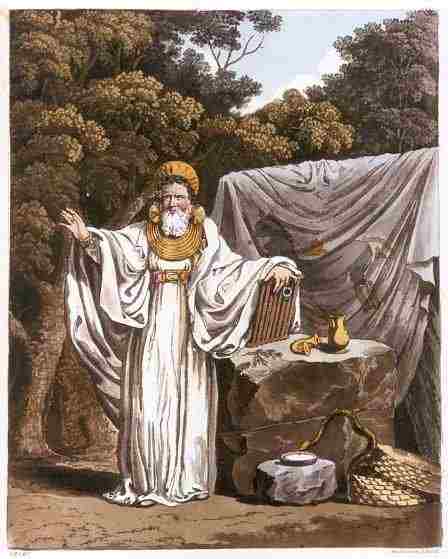
The Druid presenting his sacred items to you, to see if you remember your password…
Quite often, I see Judeo-Christians attack Pagan deities for “cross-dressing”. At the same time, their clergy, priests as well as monks, literally cross-dress 100% of the time. Yes! Your priests and monks are wearing DRESSES (robes). They are ALL cross-dressers.
Now, I know WHY they do this, so let me explain….
Our (Pagan) traditions are based on animism, the idea that there is a spirit in everything. These spirits, however, are not always clear-cut male or female. In fact, they are pretty much always hermaphroditic (both male and female). Therefore, in some European cultures, e. g. the Sun Deity was a God (like in the Greek one), and in others (like the Germanic one) a Goddess. In reality, though, the Sun deity was both male and female – everywhere.
Our forebears believed in sympathetic magic, meaning that you gain the power of what you impersonate or pretend to be. So to gain the power of a deity, they dressed up as that deity, and basically LARPed as that deity. By doing so they BECAME that deity!
Now, since the deities were both male and female, this meant that a man impersonating the deity would have to put on a robe, i. e. women’s clothing, because the deity was both male and female. And, likewise, a woman impersonating a deity had to put on man’s clothing on her upper body. For the same reason.
Now, Judeo-Christianity is completely and utterly just a cheap copy of Pagan religions, where all sorts of Pagan ideas and myths and ideals have been swallowed raw (and never digested or understood), so naturally, their clergy is just like the PAGAN “clergy”: they too “cross-dress”. Although, they have no idea WHY, and it makes ZERO sense for them to do so, and they have ZERO power over anything at all. It just proves that they never understood the customs they copied from Pagan religions.
Yet, this is the reason WHY the Judeo-Christian priests and monks dress as WOMEN. This is the why they are all cross-dressers.
In the case of the Pagans, it had nothing whatsoever to do with what we today think of as cross-dressing, there was nothing sexual about it, but as we know from crime statistics, it might well be related to that for Judeo-Christian clergymen, who are, as we all know, massively over-represented in rape cases and sexual abuse cases against especially same-sex children.
Heinrich Himmler, the head of the SS (Schutzstaffel), banned SS soldiers from openly attacking Christianity, despite his own personal disdain for the religion, for several strategic and political reasons:
1. Maintaining Public Support:
Christianity, particularly in its Catholic and Protestant forms, was deeply entrenched in German society during the NS era. Openly attacking Christianity would have alienated large portions of the population, many of whom were religious or had strong Christian cultural ties. Himmler and the NS leadership understood that the regime needed to avoid widespread discontent among Christians, who represented a significant part of the German populace. To maintain public support and avoid backlash, it was prudent not to make religion a public target.
2. Avoiding Conflict with the Churches:
While there was tension between the NS regime and the Christian churches, the National Socialists often sought to manage this tension carefully. Himmler understood that directly attacking Christianity would provoke stronger resistance from church leaders and institutions. The Catholic and Protestant churches were influential, with deep-rooted authority in their communities, and a direct confrontation could have created social and political instability.
3. Incremental Control over Religion:
Himmler and other leading National Socialists believed that, in the long run, Christianity would fade away as NS ideology and the SS’s pagan and occult-influenced beliefs took hold. However, they sought to implement this transition gradually. Himmler encouraged the spread of alternative belief systems within the SS, including paganism and Germanic mysticism, but he avoided outright attacks on Christianity to keep the process more subtle and less confrontational.
4. Hitler’s Influence:
Adolf Hitler himself had a complex relationship with Christianity. Although privately critical of the religion, Hitler recognized the political need to manage the relationship with Christian institutions. He understood the dangers of waging a direct, all-out attack on Christianity while trying to consolidate power. Himmler, being a loyal follower of Hitler’s directives, likely refrained from allowing the SS to attack Christianity as part of a broader NS strategy of maintaining public order and control.
5. Unity Among Soldiers:
The SS recruited men from a variety of backgrounds, many of whom came from Christian families. Openly attacking Christianity could have alienated some soldiers or caused division within the SS ranks. Himmler prioritized loyalty to the SS and its broader mission, and any ideological conflict over religion could have weakened this cohesion.
In summary, Himmler banned SS soldiers from attacking Christianity to avoid alienating the German public, maintain political stability, and ensure the loyalty and unity of the SS. While Himmler harbored anti-Christian sentiments and promoted pagan beliefs, he understood the importance of a more subtle, long-term approach to reducing Christianity’s influence in favor of NS ideology.
But were their concerns legitimate?
Were the Christians resisting the NS regime and ideology, and were they discontent?
Some Catholic leaders, including Pope Pius XI (in the 1937 encyclical Mit brennender Sorge), criticized the NS regime, particularly its racist ideology.
Bishop Clemens August von Galen delivered powerful sermons in 1941 condemning the NS euthanasia program, which led to a temporary suspension of the program.
Pastor Dietrich Bonhoeffer, a prominent theologian, became an outspoken critic of the National Socialists. He was involved in the Confessing Church and later in a conspiracy to overthrow Hitler. He was arrested in 1943 and executed in 1945.
Many (about 5000) individual clergy members, both Catholic and Protestant, resisted NS ideology, particularly when it contradicted Christian teachings (and it did). Some provided sanctuary to Jews, while others criticized NS policies publicly, leading to their arrest, imprisonment, or execution.
The White Rose: This was a student-led resistance group in Munich that included devout Christians, such as siblings Sophie and Hans Scholl. They distributed anti-NS leaflets, advocating for passive resistance against the regime. They were arrested and executed in 1943.
Claus von Stauffenberg, a devout Catholic, was part of the July 20 Plot (1944) to assassinate Hitler. While his motivation was primarily military and political, his Christian faith informed his moral stance against Hitler’s regime.
Henning von Tresckow, another Christian officer involved in the July 20 Plot, viewed the overthrow of Hitler as a moral imperative to save Germany from destruction.
They also saw how the Norwegian Church (i. e. 800+ clergymen) had revolted against the NS regime in Norway, in 1942, because the NS ideology crashed with their Christian beliefs, and because the NS regime there tried to replace Christianity with NS ideology. The revolt had been rather effective too, and to a large degree crippled the NS regime in Norway, making it unable to work effectively. The Germans saw the same tendencies in the German Churches, and did not want the same to happen in Germany.
Therefore, they banned criticism of Christianity for some time, thinking it would calm the Christians down a bit, and then…
… they would root out Christianity, and remove it lock, stock, and barrel, after the war had been won.
However, as you know, they lost the war. Therefore that never happened.
One of the most recurring themes of our pre-Christian history, is the topic of asking the gods for advice. You find it in the Norse sagas, in the form of “divination”, you find it in Greek sources, in Celtic sources as well as in Roman sources.
Asking the gods for advice on what to do was common! This is what they did, when they were uncertain on what to do, and when they needed advice.
Also, they had great respect for the answers they received, when they did this. To some extent, the result was law, and they were obliged to follow the divine advice!
Today many will think of this as folly, and see our forebears as superstitious, ignorant and incredibly naive.
But were they?
First of all we must understand the nature of this process. What did they do? What was this all about?
They commonly received a simple “yes” or “no” as an answer to their questions, or indeed when they asked deities directly (i. e. priests or priestesses impersonating them) they would receive answers in form of riddles – that were open for interpretation.
In Germanic cultures, in Classical Antiquity, they could ask the gods for advice by e. g. placing their spears on the ground, in a pile, and ask a young boy to ride a horse over them, to know whether or not they should go to war. If the horse stepped on one or more spear shafts, it meant “war”. If it did not, it meant “not war”. Or they cut some pieces of wood and drew some symbols (no not runes… there is zero evidence to suggest they used runes for this) on them, and then they threw them to the ground, and read what symbols appeared and interpreted the result from that.
The “problem” here is that we still do this… no, not exactly like that, but when we are uncertain on what to do, we let chance decide. And we do that by flipping a coin, by casting dice, by playing “paper, rock, scissors”, or something like that. This is the same! Yes! This is what they did in the past too, and this is “asking the gods for advice”! It was more complicated some times, like with the young boy riding a horse across a pile of spears, but it was the same. And our forebears knew this perfectly well! They knew that this was chance telling them what to do. And this chance was seen as sacred and you had to respect it.
Naturally, they only asked chance when they did not know what to do, or if their voting did not produce a clear result! If they knew what to do, they would, what was best for them, then they did that – and never needed to ask the gods (chance) for advice. Again; like we still do.
When they asked the gods or goddesses themselves (impersonated by priests or priestesses) for advice, they did not trust chance directly, but instead let someone else decide, someone impartial. If these deities were uncertain themselves, they could ask chance, in a similar manner!
The riddle as an answer served a purpose too. The deities were not always absolutely certain themselves, so they did not want to say directly what their followers should do. What if they gave them bad advice!? Instead, they commonly gave a vague and general advice, that their followers could build on, and interpret themselves – they way they wanted to.
The ritualization of all of this this served a purpose too. Common people are more impressed if you make it more systematic, complicated and incomprehensible. They will believe more in it, if you have a system that you follow consequently. “This is how it is done”, followed by a time-consuming and intricate ritual, is more convincing than “heads or tails”? Sure, the latter works too, but the former is more convincing to most people. And yes, believing in the result can be important. Not just for placebo effect, but also to take away doubt and remove and half-heartedness in people. “Whatever you do, do with all your might”, after all. Half done, is not done. Half done, is badly done.
They knew perfectly well that all of this was a matter of chance, but they grew up and were educated into believing more in chance than we do today. Yes, even more than we are today. Chance was the will of the gods! Chance was sacred! Chance was law! Chance was fate!
The difference today is mainly that we leave less to be decided by chance, and that we ask chance mainly for less important matters. “Shall we watch this or that DVD tonight?” Or “Who gets to sit in the front passenger seat of the car?” Maybe because we think we know better, and think we are better equipped to know what to do, or of course because we have lived under the tyranny of Judeo-Christianity for hundreds of years.
The Pagan ideas remain though, and are still ingrained in our minds, spirits and physical beings. We still ask “the gods” for advice. We still often let chance decide.
Predicting a fairly detailed future of individuals was done too though, but for that they used the Norns, and that is a completely different topic, that I will discuss in another post….
When I argue that Christianity suffocated Europe intellectually and spiritually, and left our culture and populations dramatically reduced in all ways, the standard reaction from Christians is to show images of the “magnificent” cathedrals built by the Christians in the Middle Ages. This is supposed to prove that I am wrong, and that Christianity did not actually turn Europeans into ignorant, filthy, broken and dramatically reduced primitives. Instead, we, they argue, became better and started to build glorious temples for the new Semitic idol. Because “of course”, before Christianity we were indeed ignorant primitives.
You can of course easily list endless examples of “glorious” buildings in biological Europe from before Christianity had even been invented. All the seven wonders of the Ancient World were built by Pagans. Every single one of them. The Greeks built magnificent temples to their Pagan Gods, and the Romans did too. They also built aqueducts, bridges, sewers, theaters and more, en masse, and even the “barbarians” of Europe built magnificent ships, the Stone Henge, the New Grange burial mound, and numerous beautiful wooden temples. Only someone extremely ignorant will believe in the lies of the Christians. Even civilization itself was built by Pagans. In Europe by the Romans and Greeks. And it barely survived Christianity!
But they are correct that the architecture skills in Europe survived Christianity. And it did because the Christians wanted to build temples to their immigrant idol, to impose their Semitic beliefs on the Europeans, to force them to worship their Hebrew tribal “god”, to scare them and to ensure control. These temples were not only temples, but also intelligence gathering centers, where any and all opposition could be picked up, identified and “dealt with”.
And they did “deal with” the Pagans in all areas they took over. They burnt the Pagan temples, often with the Pagan priests inside, executed all who refused to bend their knee to the new Semitic idol and ruthlessly rooted out all European culture, as best as they could. When they failed, they Christianized it instead, and made it part of their own alien cult. Like they did with all our Pagan festivals.
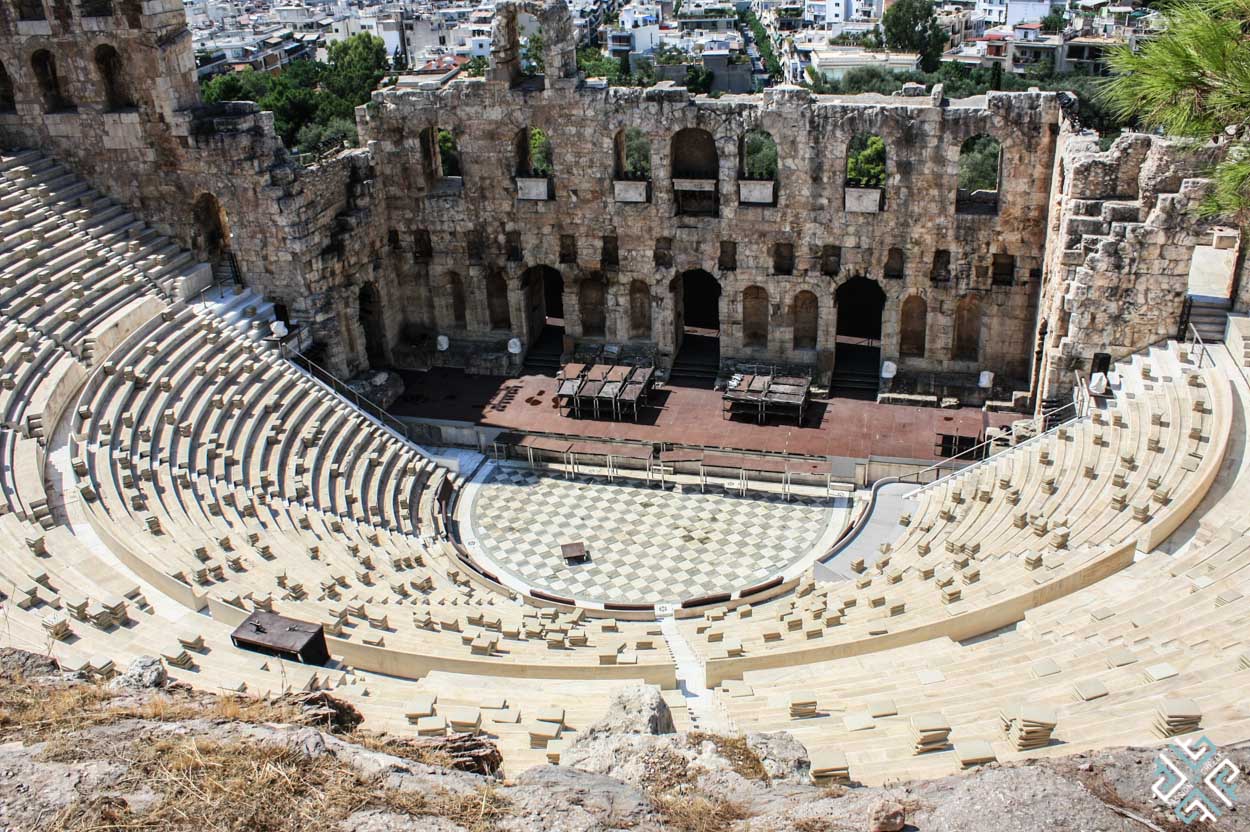
The fate of everything else, everything except architecture, is a different story. And even in architecture Europe lost much. Existing buildings were not only neglected by them, but were actually also vandalized and often destroyed, and many building techniques were forgotten. Streets and bridges made by the Pagans were still used, but they built no new roads and did not maintain the old ones. The new bridges they built were of vastly inferior quality, and none of them survived time. The old roads and bridges, built by Pagans, survived only because they had been so well made. Public baths, sewers and aqueducts were destroyed by them, or left unused. Eventually they collapsed, of course. When you see images of Ancient Greek open theaters, overgrown and abandoned, you must understand that they did not “fall out of use”, but the use of theaters was banned by the Christians! Acting only survived as Christian propaganda, and this was done as in religous plays in the churches themselves.
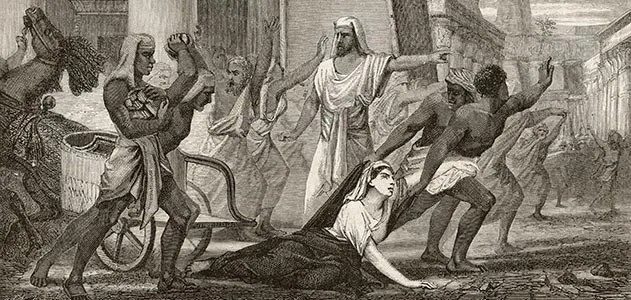
Below: Hypatia (a Greek living in Alexandria, then part of the East Roman Empire) murdered, by a Christian mob.
Old Pagan philosophy schools, sports arenas, baths, horse racing courses, libraries, and so forth were all shut down. More than ten thousand libraries in Europe were burnt down by the Christians! Sport itself was suppressed and partly survived only because it was practiced in remote locations out of reach of the power of the church. Only religious sculptures were allowed, and they were made of inferior materials and in a quality and with a technique vastly inferior to that of the Ancient Pagan world, and nothing even half-way comparable to the Ancient sculptures were made until the Renaissance (of Pagan ideas and ideals!).
When it comes to philosophy, the Church burnt all existing works, with only a few exceptions (mainly in the East Roman Empire), where they kept them hidden from the public. They established a monopoly for philosophy. Real philosophers were censored, persecuted, and even murdered. Nothing of any value was made from the time the Christians murdered Hypatia during the Christianization of Greece, until the Renaissance, when ancient Pagan philosophy was revived. And I may add that the Renaissance was possible only because the Muslims had kept much of the Ancient philosophical works that they had come across. When the Muslims were defeated, in Spain and Portugal, as well as in North Africa and the Middle East, many of these ancient Pagan works were found by European knights, and brought back to Europe. Also, when the Muslims defeated the East Roman Empire, and sacked their capital, the old libraries of the elite, where the Christians had secretly kept some of the ancient European texts, were plundered by the fleeing Greeks, who brought these books as refugees to Italy (mainly). Books were very valuable at the time, so they did that to sell them them; to make sure they would have some money when they arrived, and thus an ability to survive there.
Education was common in the Ancient world, and everyone had been taught to read and write. Public schools were built and paid for by the rich! After Christianity though, all education was denied for almost all Europeans, except to a few rich people and those who planned to become priests. Education became limited to Christian indoctrination.
It does not stop there though! Dance was banned as “Pagan”, tribalism was of course banned and replaced by Christian kingdoms, history was replaced by pure fabrications and lie-propaganda, and mathematics was treated as Pagan philosophy and was reduced to the simple arithmetic needed to calculate the date of Easter. All medicine was banned, and diseases were instead seen as rightful punishment for sins. Hygiene was abandoned as un-Christian. Painting too was banned, except for religious themes for use in Christian propaganda and churches. Pre-Christian art was destroyed whenever they came across it. Most painting techniques were forgotten, and lost for centuries, until they were re-discovered because of the Renaissance (of Pagan ideas and ideals).
When you see magnificent paintings and sculptures appearing in Christian Europe, in the 14th century, this is because of the Renaissance of Pagan ideas and ideals.
And how did the Christians react to that!?
Yes! This is the moment in history when they started burning “witches”. They saw their monopoly and power disappear, as more and more Europeans returned to their own roots and embraced Pagan ideas and ideals again. So the Christians fought back, to keep their power! They did that by murdering more Europeans, by torturing them and burning them alive, in public, to “scare straight” the Europeans. And of course, they murdered mainly those who were the keepers of the Pagan traditions: women. In particular the midwives.
Yes! The Pagan tradition was kept mainly by women, just like all traditions even today are. Mainly women keep the traditions. Without our women, even Yule and Easter, would have been lost ages ago already.
And this is where it gets interesting, because the church mainly murdered women in Protestant countries. Why?
Well, the Protestant countries were “by chance” also the countries that had been Christianized last. In Southern Europe, the Christians had destroyed everything Pagan for hundreds of years already, even for a thousand years, so there was very little left to destroy there. Even the populations themselves were largely mixed with North Africans and Semitic peoples. When the Renaissance re-kindled old ideas and ideals there, and not least skills, the Pagan awakening was not as dramatic as it was when these ideas and ideals reached Central, Western and Northern Europe. In these mainly Protestant parts of Europe the European blood was still overwhelmingly dominant. The Pagan memory was still very much alive. Christianity had not yet had the time to destroy their blood and heritage completely. It was still “too easily” re-kindled there. And dramatic measures were necessary, to stop that!
I can add that when they had burnt most of our midwives, the traditional sages and keepers of (Pagan) traditions in Europe, they replaced them with male doctors, and the mortality rates for both new-borns and women giving birth sky-rocketed. When it had been fairly safe to give birth before, it from then on became incredibly dangerous to give birth.
An ancient Greek theater. Fallen into ruins, because the Christians BANNED theaters. Partly repaired in modern times.
The conclusion I will draw from all of this, is that yes, architecture survived Christianity, and “glorious” temples for their Semitic “god” were indeed built in Europe, before the Renaissance of Pagan ideas and ideals, but everything else was banned and if possible destroyed by Christianity. Intellectually and spiritually, and even physically, Europe was sent into a dark abyss by the Christians, and we only survived because we found back to our Pagan roots.
We are still in this dark and dangerous Semitic abyss. But we are slowly and surely saving ourselves, from the plague called Christianity. Many keep falling, and err in the darkness, but many others or later also manage to climb out and see the light again. Like people emerging from Plato´s cave. Thankfully, only some of us, the most broken, useless and worthless amongst us, are still blinded by the idiotic lies of Christianity.
What started with the Renaissance is not over yet. We are still waking up. And fear not, fellow Europeans! We will wake up completely, before they manage to destroy us and wipe our name from the records of man.
We know of several mystery cults from the Classical world; the most famous being the Eleusian Mysteries and Mithraism. What was common to them all was that they all included an initiation using sacred objects and a mystery chamber. Another thing they had in common was that they all appeared in the civilized parts of the world.
Here I will explain what they were all about, why they appeared where and when they did, and also what the “barbarian” equivalent was – and also what the roots to all these cults were. I will also show examples of cults deriving from this that still exist today.
The first thing we need to understand in order to comprehend anything in this context, is that all the ancients believed in reincarnation, and that this was the focus of their traditions. This was the purpose of their religious efforts. When we see caves from tens of thousands of years ago, here in Europe, with petroglyphs and the footprints of 7 year-old children in the sand, we need to understand that this is the Stone Age equivalent of a mystery chamber! Inside you would find a priestess or a priest, a gate keeper, whose purpose was to test you. Not just in the “are you worthy” sense, but also in the “is it really you” sense.
The sacred objects, presented to you in this mystery chamber, had a twofold meaning: “Can you recognize the right sacred object?” (to prove it is really you!), and “Find back to yourself!” (if it is truly you, and you identify the right object). You would enter the chamber, be presented several objects, and only if you identified the right one, you would be allowed to proceed to the next chamber. A priestess or a priest would also ask you a question, that you would need to answer correctly. The ultimate question would be a sacred password, that only “the right one” would know. And yes, that password would be… your own name. You true secret name, that you possessed in a previous life, and that you told to the priestess or priest, for her or him to keep it secret until you returned.
The sacred objects would be the items you had been buried with, mixed up with several other similar items, to ensure that no “trespassers” would enter and claim your spirit. If it was really you, only you would be able to identify them correctly! Imposters would not be able to do that!
In our own day and age, a part of this ancient tradition is still partly in existence in Hinduism and Buddhism: the Dalai Lama and the Kumari are both found using this tradition.
Like I said, this tradition stems from the Stone Age. The origin lies in our Neanderthal forebears. We see clear archaeological evidence that they did the exact same, as our forebears did in pre-Christian historical Europe. Not just in Ancient Greece or Ancient Rome, but all over Europe.
A Druid, a Celtic “midwife of the mind”, with his sacred objects:
We even have some of the riddles presented to the reincarnating dead, in the Eddas, in Alvíssmál as well as Hárbarðsljóð. In fact, it is likely that most of the Edda poems were actually such riddles, but these two are absolutely obviously that. The dwarf in Alvíssmál wants to marry Thórs daughter (i. e. a mythological way of saying you want to be reborn), and has to win in a knowledge contest, but fails. Then in Hárbarðsljóð we have Thór himself who wants to cross a river (i. e. a mythological way of saying you either die or want to be re-born), and faces a ferryman challenging him to a wisdom contest.
This is how it was done: you would enter the mystery chamber, be presented with one true and several false sacred object, and if you picked the right one, you would be presented with some riddles, that you needed to solve in order to continue to the next chamber. Then you would be presented with more items, and again you had to pick the right one, and answer more riddles, before you could continue. You would only be reincarnated and be able to claim all the sacred objects as your own if you picked only the right items every time and also were able to solve all the riddles, as well as know the ultimate secret password at the end: your true name, that only the priestess or priest would know!
This was done at the age of 7, and the victorious child would ultimately leave the burial mound with all the sacred objects as well as the skull and femur of the dead, lying in the ultimate chamber.
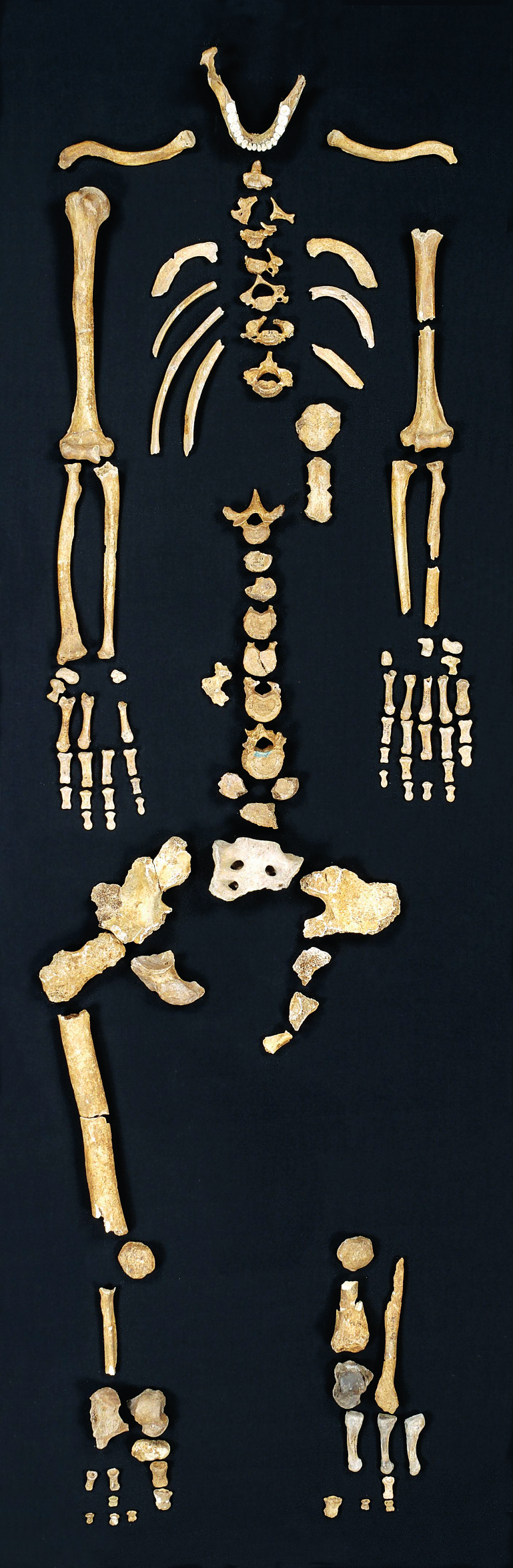
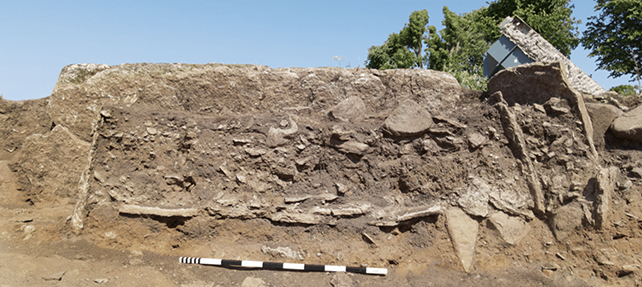
And yes, we have actual physical evidence to support what I say here: all the way back to the Stone Age, and the Neanderthals, and all the way up into historical times, we find burial sites with remains lacking both the skulls and the femur (or they have been replaced with bear skulls and the femurs of a bear). We also find the burial sites “plundered” – which of course means simply that the person in the grave had returned to re-collect the sacred objects that were rightfully his own! He had been reincarnated!
70.000 (!) year old Neanderthal remains, from Le Regordou, in France, with the head and femur missing.
5500-year-old burial mound in Tiarp, near Falköping, in Sweden, with 12 bodies. “By chance” all missing their skulls. Naturally, the “scholars” think they have been “beheaded”. Sigh.
The image of a greedy and bearded, and rather ugly, dwarf stems from this too: the little child greedily sought his precious sacred items (often made of gold, in order to last in a grave), and then left the burial mound holding much golden items and the (often bearded, and always kind of grotesque) head of his former body victoriously above his head. As I have explained in other books, “dwarf” means “opening in the ground” too. That is, whence the child comes when he is reborn.
The “problem” with this ancient reincarnation cult though, was that it was not really for everyone. Only a select few would be able to reincarnate this way. Only a select few would even be given a burial mound to begin with! The rest?
Likewise, today, only one individual in Hinduism reincarnates as the Dalai Lama. Only one single individual reincarnates as the Kumari – although they “lose” their role as the Kumari when they start to menstruate there, and then a new one needs to be found, so in a sense several women have been the Kumari, but only one at a time.
It is still a custom in Europe though, to name your children after your dead relatives, to put images of them on the mantlepiece (where they in the past put carved wooden figurines of them or their skulls on the mantlepiece), so we should reconsider the claim I make above here. Certainly there was some sort of reincarnation for everyone, but… only some would return as deities.
Yeah, I know: we have “Pagans” today who worship the gods, make sacrifices to them and think they are real physical beings on Earth. They list historical examples of god-worship, and claim this is how you shall do it. But they fail to understand that the gods, the actual and real gods, are deities reincarnated in human beings. That is: human beings reincarnated as gods. These deities were indeed given a special treatment in the past, and were hailed as real physical gods here on Earth. Like the Dalai Lama and the Kumari still is. Yeah, they still give offerings to the Kumari…
Indeed, the Lord of any ancient Germanic society was Freyr. And Lady of any ancient Germanic society was Freyja. The head of any tribe was a god, and his wife was a goddess. They had gone through the ritual reincarnation of the deity, so… they were the deities!
And yeah, we have actual evidence supporting this claim too: even after the Christianization (i. e. the “we pretend to accept your immigrant cult in order to avoid torture and death”), they still practiced this in Scandinavia. The family head of any farmer family still was a deity. When he died his throne would remain unused until one of his sons reincarnated – not as him, but as the same deity! In order for this to happen, he would need to first kill the deity, i. e. cut a wooden idol with his sword, and then become the deity himself. We see remains of this in form of traditional “sword dances”, but of course also in the Arthurian mythology, where the sword has become stuck in the idol!
You see, when the son cut the idol, he would make a promise, to do something spectacular! This was known in Scandinavia as a “Bragi promise”, from the deity “Bragi”, meaning “best”. If he e. g. promised to “unite all the tribes in England and become king there”, then he would have to do that in order to become the deity.
However the deity was in charge here, so if the sword got stuck in the idol, and the next in line could not get it free, he would not become that deity after all! And the next in line would be allowed to try pull it out. If he too failed, then the next in line would try, etc. etc. etc. In the Arthurian myth the idol is a rock, but this is the same, and ultimately the god choses a little boy, Arthur, to become him! The myth suggests that when he manages to pull the sword form the idol, he is destined to become king, but… in reality, the one who pulled the sword from the idol had to perform the act of heroism promised by the one cutting the idol! In the case of Arthur (meaning “bear”, btw…), this would be to become king.
I can also add that the symbolism here is that the idol is the placenta, and the sword the umbilical cord, and in order to be reborn, you naturally have to “free the umbilical cord form the placenta”. If you do not, when you are born, you will die.
These real gods, these deities reincarnated in man, were given special attention by the others, yes. They were hailed as real gods. They were real gods!
They would transfer divine blessings to others by placing their swords on the shoulders of their subjects, by letting them drink from the cauldron of the lady, etc., but they also had severe restrictions. E. g. They some times (as seen with the Kumari) could not touch the ground, and were therefore carried around in thrones or standing on shields (as is best known to us from the French cartoon Asterix, actually). The goddesses could not bleed (again: as seen with the Kumari), they had to wear clothes in certain colors, etc. It was no easy task, being a deity… You can read more about these “taboos” in Sir James Frazer´s “The Golden Bough”, btw, if you are interested.
It is still unclear to me, whether only the gods would reincarnate, or if there was a general belief in reincarnation for everyone. Or perhaps if everyone reincarnated, but in order to reincarnate as a god, you would need to go through a special ritual. From what I can tell, the latter is the most likely. I hope I will understand this better, but for now, I will simply present to you what I do know.
It seems though, as if in Classical Antiquity, the mystery cults appeared because something had been lost by the adoption of civilization. Too many ordinary people, too little direct contact with the natural world and of course, a diminished human species.
It was no easy task being worthy of reincarnation. With civilization, more and more failed, until so many were “uninitiated”, and so many failed to see the purpose of it all, that they could be lured into universal cults where everyone, the more inferior the better, were accepted and approved of.


 Thulean Perspective