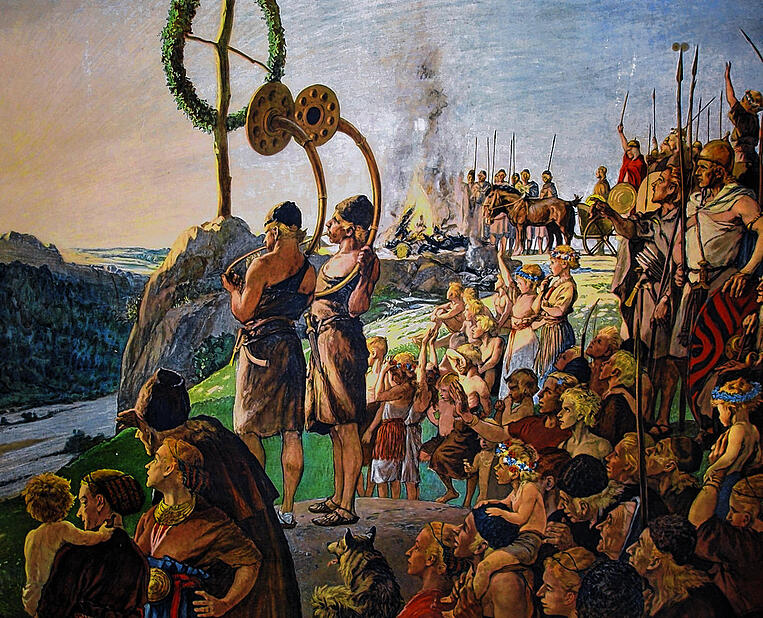
The Noble Savage

According to Ovid, The Golden Age was a time of perfect innocence and harmony. Humanity lived without laws, toil, or fear. The earth provided for all, and there was no need for labor, war, or travel. People were just by nature, not by compulsion.

“The golden age was first, which, without a ruler,
cherished of its own will faith and right.” (Metamorphoses I.89–90)

No ships (no navigation or seafaring), no agriculture/animal domestication or tools, no metal use, no cities, no states, no private property, no laws, no warfare, no need for houses (they lived in caves), no architecture, no clothing, or toil. People lived directly from what nature provides (as hunter-gatherers) in small, egalitarian groups. And yes, this describes the Paleolithic perfectly….

Ovid describes it as a natural paradise, where man lived in simplicity and peace.

***

The Silver Age began when Jupiter (Zeus) overthrew Saturn (Cronus) and introduced the first decline. Seasons appeared, ending eternal spring. Men had to build shelters and till the soil for food. This was the age when hardship and labor entered the world.

“Then Jupiter shortened the period of ancient spring,
and through winter, summer, and unequal autumn
and short spring, made the year revolve.” (I.112–114)

The sun’s course divided the year into seasons. Men had to use agriculture and build homes. Though still pious, men began to lose innocence and grew more dependent on toil. This, naturally, describes the Neolithic perfectly…

***

From this came the Bronze Age and it was rougher and more warlike. Men became fiercer and quicker to arms, though not yet wholly wicked.

“Next came the brazen type of man, more fierce in temper,
and readier for war, yet not impious.” (I.125–126)

Courage and conflict replaced the innocence of earlier ages. Still, some sense of honor and restraint remained.

***

Then finally, we arrive in the Iron Age (the age of Ovid’s own time, Classical Antiquity), the nadir of human morality. All virtues vanished; greed, fraud, and violence prevailed. Men sailed the seas, claimed private property, mined the earth for wealth, built cities, states, and even empires, and waged war on one another. Faith, truth, and modesty fled from the earth.

“Straightway all evils burst into this age of baser vein:
Modesty, truth, and faith took flight,
and in their place came fraud and trickery,
violence and the wicked love of gain.” (I.129–131)

Humanity desecrated nature and the gods. Ovid’s tone is mournful, lamenting mankind’s moral decay.

***

But what is ‘the desecration of nature and the gods’? According to Ovid, this is the exploitation of resources, rather than living in harmony with nature. This is a disrespect of the divine law and order, through violence, impiety, and greed.

He is lamenting the decline as tragic: humanity is capable of great virtue, but it has turned away from the harmony of the Golden Age. In other words: Ovid mourns what humans have lost, not what they have gained materially. Technology, war, and law may advance, but they represent a moral decline, which is the real tragedy.

As you can tell, this is in direct contrast to modern archaeology, where every technological achievement is seen as an ascent.

The ancient way of thinking was that the more men work, build, and exploit nature, the more they lose virtue. Technological advancement and moral decline go hand in hand. Each invention or discovery that makes life materially easier also takes mankind further from natural virtue and divine harmony. The modern way of thinking, on the other hand, is that the more men work, build, and exploit, the more they gain mastery and power, and the more advanced they are.

This anti-modern view was not just something we find in Ovid’s writing, though. It was deeply rooted in Greek thought before Ovid: Hesiod (8th century BC) had said exactly the same in Works and Days: that life worsened as men invented crafts, weapons, and cities. Lucretius (1st century BC), though an Epicurean materialist, also describes early man as closer to nature and therefore more innocent. Virgil, in his Georgics, longs for the rustic simplicity of the early world.

In other words, for the ancients, “progress” was moral regression. Technology, wealth, and mastery over nature were not triumphs, but symptoms of alienation; the loss of the divine harmony that once guided human life.

Conclusion:

Long before Rousseau, the ancients already idealized the uncorrupted natural man; the one untouched by luxury, money, or empire. When Rousseau (18th century) wrote of the “noble savage” (the natural man unspoiled by civilization) he wasn’t inventing a new idea. He was reviving the classical Pagan idea of the Golden Age, reinterpreted through modern philosophy. Rousseau’s “state of nature” is simply Ovid’s “Golden Age” restated. Rousseau gave it a social-contract framework; the ancients gave it a mythic and moral one. But the underlying idea is the same.

Man is born good in nature and becomes evil through civilization.

This skepticism toward technological and social ‘progress’ is characteristic of the Pagan worldview. The noble savage represents the ideal Pagan man: morally virtuous, living in harmony with nature, and uncorrupted by wealth, luxury, or social artifice.

For us today, I would claim that we should hope for individuals (likely) and entire socieites (less likely) to recover virtue and live according to nature (and thus the divine), by using knowledge and tools wisely rather than letting them enslave the soul. The virtuous man has a moral armor, and are less susceptible to the chaos, greed, and other corruption that sweep through our societies today. When others fall, the true Pagan will maintain integrity, be self-sufficient, live in harmony with nature, and have association with like-minded people (only?).

Varg Vikernes

Sources:
Hesiod (Erga kai Hēmerai), Lucretius (De Rerum Natura), Virgil (Eclogues, Georgics), Seneca (De Vita Beata, Epistulae Morales ad Lucilium, and De Beneficiis), Tacitus (Germania), Ovid (Metamorphoses).

Ancient Pagan Rituals: Myth as Memory System

Long before modern hospitals, psychologists, or neuroscientists, our ancestors developed elaborate rituals to preserve identity, memory, and knowledge across generations. Interestingly, this was a system remarkably akin to modern techniques used to treat amnesia. While cloaked in myth, symbolism, and ritual, these practices were far from arbitrary. They were designed with purpose, subtlety, and astonishing psychological insight.

The Pagan traditions, sacred items, burial mounds, and ceremonial acts were tools to restore the memory and identity of returning souls or reincarnated children. Items buried with ancestors weren’t intended merely to accompany them in some afterlife, they served as anchors for memory, cues to help the newly incarnated recognize themselves and reclaim the knowledge, skills, and possessions of past lives.

A trusted guide (often called a sorcerer, druid, or “midwife of the mind”) would oversee this process, ensuring that only the rightful individual could reclaim their legacy. These guides were ritualistically trained to present objects, locations, and symbols in ways that awakened recognition and understanding.

Most myths, far from being whimsical tales, encode this memory-restoring process, as explained and exemplified in detail by my wife (Marie Cachet) in her book, The Secret of the She-Bear.

Today, therapists use remarkably similar methods to help amnesia patients:

  • Patients are exposed to personal items, photos, or objects tied to strong emotional memories (= burial mound possessions).
  • Familiar environments are used to trigger recognition and memory reconstruction (= sacred places, sacred trees, ceremonies, traditions).
  • Guided therapy helps patients restore identity and integrate lost knowledge (= the guidance of the sorcerer).

The logic is the same: memory is recovered through context, emotional attachment, and guided recognition. Ancient Pagan rituals accomplished the same thing, but in symbolic, narrative, and ritualized form.

Conclusion:

These practices were not arbitrary or naïve. They reveal that our ancestors had a systematic understanding of how memory and identity could be restored across lifetimes. To remember was to return; to recover not only knowledge, but the very self carried from a prior existence. What modern neuroscience describes clinically, ancient rituals achieved symbolically and ritually, with the same underlying logic of continuity.

By studying these traditions, we uncover not superstition, but a rational framework of practical intelligence: a method by which reincarnation was guided, memory was reawakened, and identity was re-established in the living.

Varg Vikernes

Understanding IQ in Europe

Quite often I use the argument that eye- and hair-color are good indicators of racial purity for Europeans. Those are recessive traits, and if your phenotype is recessive, then of course your genotype is too. If you look Nordic, you are Nordic! And yes: the Nordic look is the original European look: for all Europeans! Naturally, if you have some non-European traits, like dark brown or even black hair, and brown eyes, then you obviously have some non-European admixture. Not much, necessarily, but some, yes. If you are European though, you probably still are overwhelmingly Nordic, but those dominant non-European traits overshadow your “Nordic core”.

Now, the reaction when I say these things is often that “Vrag claims albino Africans with blonde hair and blue eyes are Europeans”, or something like that. This is obviously a strawman: I am talking about Europeans. And non-Europeans, i. e. individuals who clearly are not Europeans, who in spite of that have European features (fair skin, blue eyes or blonde hair) are obviously still not Europeans, but actually non-Europeans with some (!) European features. They clearly have European admixture though. And perhaps ironically, often more so than very dark individuals with European passports.

There are other features than the three mentioned above, that make you European. Skeletal shape, not least skull shape, is perhaps the most important. I only use those three as examples, because they are the most obvious, the most visible, and therefore very easy to measure.

The topic I wish to discuss here though, is one argument often made, when I talk about this. You see, many claim that I omit to talk about “what really matters”, and they list IQ as a determining factor for racial purity.

Really?

I could destroy their argument by simply stating an obvious fact: There are individuals with very high IQ in all races, so no, IQ in itself is not a determining factor for racial purity for Europeans. But I will say more…

Since the start of agriculture, in the late Stone Age, Europeans have developed from being a very homogeneous group (and yeah: I am also talking about IQ here) to splitting up into different… classes. Civilization naturally accelerated this dramatically. Instead of a race of nobles, our race developed into a race of nobles, middle class people and workers.

One group became lords (“distributers of bread) and ladies (“bread bakers”), another group assisted them, and a third group did all the manual labor. The need for high IQ was high in one group, not so high in the other, and low in the third.

When before the individuals with low or even just medium intelligence had perished, because life as a hunter-gatherer in Europe (!) demanded the ability to find quick and good solutions, plan ahead and make preparations for winter, and because the tradition of that time weeded them out (I will talk more about that another time), they now were able to survive. Even thrive, by doing manual labor for their lords. They not only survived; they multiplied, and made up an increasingly larger portion of the populations.

Note: in Europe they were (most places) all of the exact same race…

With time, the lords and ladies remained highly intelligent, because they still had to be, in order to manage the administration of society, and they could cherry pick when they married. The less desirable nobles would fall into the middle class. The more desirable middle class individuals would be adopted into the nobility. The less desirable middle class individuals would become workers. The more desirable workers would become middle class. The rest of them would remain workers. Quite simply. Quite logically.

And no: they did not have strict rules for inter-class marriage. This came later on, when the nobility became increasingly scarce, and the workers too numerous, and indeed when they started taking slaves (workers) from other races – which indeed happened in the border regions of Europe. And yes, this explains the non-European admixture in even ancient European peoples living on the edges of Europe (that I started talking about in this post).

The most extreme example of this is of course Ancient Egypt, where the royals only were of European descent, and the rest of the population was not. In the end, the royals even married their own siblings, in order to “keep” the high intelligence and race, but of course ended up horribly inbred. Ultimately they died out (or perhaps emigrated to Ireland), and Ancient Egypt as a civilization collapsed.

Today the average IQ in Europe is about 100, give or take a bit, depending on where in Europe we travel. This is the average though. The median value for working class Europeans is probably only around 80, for middle class people around 110 and for upper class people around 130. They are all perfectly European though. So no, you cannot use IQ as a determining factor, for racial purity. You can use eye-, hair- and skin-color for this though, when coupled with skeletal shape of course.

The average IQ is around 100 though, simply because the most of the time perfectly European low IQ workers are more numerous.

Yeah, all of this means that most Europeans have an IQ of less than 100!

And to make it perfectly clear: median values and averages like this, do not mean there are no exceptions, in each and every social class! But when this happens, they tend to move up or down on this class ladder. Stupid people sometimes have children smarter than themselves. Smart people some times have kids dumber than them. Nothing is fixed or perfectly predictable in this context. When this happens, the kid will move up, or move down, on the class ladder.

The problem today is the same as when agriculture was introduced: society stimulates the dumb to have more kids than the smart, and also enables them to survive regardless. So the trend continues: we see more and more stupid people in society, and fewer intelligent people. Agriculture and civilization leads to idiocracy, unless perhaps strict eugenic rules are implemented.

Note though, that more and more stupid people are produced by this type of society also because they are needed. In order to keep the wheels running, you need people stupid enough to tolerate doing boring tasks, over and over again, without losing their minds. The low IQ workers are incredibly useful! The more, the merrier, for those in power! These low IQ workers will do all the tedious tasks, and be happy if you only throw them a little entertainment at the end of the day. First of all football and TV, but other things too – games, shopping, vacations etc. etc. etc.

No! If you are highly intelligent, and placed in the shoes of a worker, a bus driver, a cashier, a factory worker, a taxi driver, or whatever, you will be miserable. You will probably end up killing yourself. Society needs people with low IQ to fill those roles!

This is perhaps a digression, but if you read “Hitler´s Tabletalks”, you will also see that Hitler too was fully aware of this, but he was massively pro-civilization, so he encouraged those low IQ Europeans to breed: the more the merrier. He even handed out medals to the working class women who produced many low IQ children! He wanted more stupid workers and more stupid soldiers! Of course: they are the pre-requisites for a civilization to function!

When I talk about blue eyes and blond hair being determining factors for race, I am not discussing intelligence or class-related issues at all. I am not talking about civilization either. Those are separate issues, and I am fully aware of the fact that we need more intelligent Europeans, first and foremost. But no: intelligence in itself is not a factor for determining racial purity.

It should be, and I hope it will be, again, but it is not.

The essential point I wish to make here is that before we focus on IQ, we need to determine what group of people are actually our own, to begin with. When we have, we can work to improve the IQ in our group. The swarthy features (dark brown hair, black hair, brown eyes etc.) in our own group are there because of non-European admixture, and yes, we should work to remove them, over time (with eugenics etc.). And yes, the low IQ in our group is there because of agriculture and civilization, and hybridization too, and we should of course work to raise the average IQ as well. The ideal is a purely Nordic race made up of only nobles with a high IQ.

Dixi.