The Dwarf: Meaning & Origins

Dwarves? What are they based on? What ARE they?

They were originally maggots in the corpse of Ymir, the primordial ettin, and they were given a human-like shape by the gods.

Quite enigmatic, isn’t it?

The thing is, the ettin (the ogre of the fairy tales) is ‘the twin’ that we know, for example, from the tale of Romus and Romulus, and that is always killed in the myths. It is killed because it has to…

Again rather enigmatic, isn’t it?

Yes, and it is intentionally so. Because the purpose of our mythology was to test the young, their wits, and their ability to remember. Therefore it was intentionally enigmatic, and intentionally impossible. Yes! Filled with creatures that don’t exist, situations that are absurd, claims that are contradictory, and quite simply impossible. The first step to uncover the hidden meaning behind these myths is to acknowledge that: ‘This is impossible‘.

When you understand that it is indeed impossible, you can also understand that there must be something else said by this. If there are no eight-legged-flying horses, or goats pulling wagons through their air, or ettins, or dragons, or hammers that return to your hand when you cast it, then these things must be something else. They must represent something else.

In Norse, we know such things as kennings, or ‘poetic metaphors’, as we would say in English, but also as heiti, or ‘compound metaphors’, as we would say in English.

Now, you can always believe that these impossible creatures and powers are real, and I would be a fool trying to deny you this belief! Be my guest! Remain in ignorance! See if I care! In fact, you should remain in ignorance, if you cling to these childish beliefs and refuse to listen to what I have to say about this, because that means you are not worthy. You do not understand, and you do not remember. You are probably not a reincarnated ancestor. Just some brand new ‘spark’ in this world, with no roots, no past, and no future. This is not for you, pleb. Send your wish list to “Santa Claus”, and keep believing.

If you, on the other hand, understand that there must be something else in these myths, you have the wits needed, and you probably do because you remember.

I just made this up? Like some claim?

No. If you remember Socrates, who in Plato’s dialogues discusses the idea that learning is actually anamnesis; a form of remembering. This is well known from Meno, where Socrates suggests that the soul already possesses knowledge from past existence, and that what we call learning is merely recollection.

So no. I am not making this up. This is not just some philosophical dialogue from Greece, but actually how all pre-Christian Europeans saw things. The mythology is the means to test this, to see if the child remembers. If the child doesn’t remember? Then he is not a reincarnated ancestor…. As simple as that.

But if the children do remember what the compound and poetic metaphors of the myths actually mean, what the myths tell us, their own past name even, then they are their ancestors, and will be allowed to claim their own identity. And possessions…

And these children, who started out life in the womb of the mother as little ‘maggots’, alongside their grotesque ‘twins’ (placentas), grew and grew, and whilst growing they learnt from their ancestors, Óðinn, by drinking from the Well of Mímir (that ‘by chance’ means ‘remembrance’). That is, in normal terms: they were built and shaped and nourished in the womb by the placenta, via the umbilical cord.

At birth they had to fight a dragon, and cut its head off. That is, they had to cut the umbilical cord.

So much for birth…

Those who ‘remembered’ would, around age 7, be allowed, after proving that they indeed remembered, to enter the burial mounds of their ancestor, to claim his possessions, his life, his name, and his spirit, for themselves. Therefore, they took his thigh bone (life), his skull (mind/spirit), and his valuables (memories), that he had been buried with, and emerged – from the burial mound, the womb of Mother Earth – reborn as him. Themselves given to themselves. Not born, but reborn.

And when they did, they were called ‘dwarves’….

Greedy? Because they craved for the valuables, gold, in the grave, and greedily collected it, to re-possess it.

Small? Because they were 7-year-old children.

Bearded? Because they held the bearded head of their ancestors above their heads, when they emerged.

Skilled? Well, they held in their hands only the most precious items they had owned in a previous life. Well-crafted items of high quality!

Underground creatures? Because they emerged from the burial mound…

Yeah, that is the mythological Dwarf. And what do you think ‘dwarf’ means? The meaning was lost for a long time, but we (I actually) have remembered it. We can tell from the female form, ‘dyrrgjá, from proto-Nordic ‘dwerge’, meaning ‘door’ (dyrr) ‘opening in the ground’ (gjá). Yes, it is a reference to whence they come: from the opening of the burial mound. Before that, when the child enters, it is just a child. He has no bearded skull in his hands. He only becomes a Dwarf when he emerges with the bearded skull from the opening in the ground.

I could say more, there is much more to say about this, but not today.

Maybe you can remember the rest all by yourself?

Our ‘scholars’ sure don’t…

V.

Cross-Dressers…

Quite often, I see Judeo-Christians attack Pagan deities for “cross-dressing”. At the same time, their clergy, priests as well as monks, literally cross-dress 100% of the time. Yes! Your priests and monks are wearing DRESSES (robes). They are ALL cross-dressers.

Now, I know WHY they do this, so let me explain….

Our (Pagan) traditions are based on animism, the idea that there is a spirit in everything. These spirits, however, are not always clear-cut male or female. In fact, they are pretty much always hermaphroditic (both male and female). Therefore, in some European cultures, e. g. the Sun Deity was a God (like in the Greek one), and in others (like the Germanic one) a Goddess. In reality, though, the Sun deity was both male and female – everywhere.

Our forebears believed in sympathetic magic, meaning that you gain the power of what you impersonate or pretend to be. So to gain the power of a deity, they dressed up as that deity, and basically LARPed as that deity. By doing so they BECAME that deity!

Now, since the deities were both male and female, this meant that a man impersonating the deity would have to put on a robe, i. e. women’s clothing, because the deity was both male and female. And, likewise, a woman impersonating a deity had to put on man’s clothing on her upper body. For the same reason.

Now, Judeo-Christianity is completely and utterly just a cheap copy of Pagan religions, where all sorts of Pagan ideas and myths and ideals have been swallowed raw (and never digested or understood), so naturally, their clergy is just like the PAGAN “clergy”: they too “cross-dress”. Although, they have no idea WHY, and it makes ZERO sense for them to do so, and they have ZERO power over anything at all. It just proves that they never understood the customs they copied from Pagan religions.

Yet, this is the reason WHY the Judeo-Christian priests and monks dress as WOMEN. This is the why they are all cross-dressers.

In the case of the Pagans, it had nothing whatsoever to do with what we today think of as cross-dressing, there was nothing sexual about it, but as we know from crime statistics, it might well be related to that for Judeo-Christian clergymen, who are, as we all know, massively over-represented in rape cases and sexual abuse cases against especially same-sex children.

Thank you for your attention.

Divine Advice

One of the most recurring themes of our pre-Christian history, is the topic of asking the gods for advice. You find it in the Norse sagas, in the form of “divination”, you find it in Greek sources, in Celtic sources as well as in Roman sources.

Asking the gods for advice on what to do was common! This is what they did, when they were uncertain on what to do, and when they needed advice.

Also, they had great respect for the answers they received, when they did this. To some extent, the result was law, and they were obliged to follow the divine advice!

Today many will think of this as folly, and see our forebears as superstitious, ignorant and incredibly naive.

But were they?

First of all we must understand the nature of this process. What did they do? What was this all about?

They commonly received a simple “yes” or “no” as an answer to their questions, or indeed when they asked deities directly (i. e. priests or priestesses impersonating them) they would receive answers in form of riddles – that were open for interpretation.

In Germanic cultures, in Classical Antiquity, they could ask the gods for advice by e. g. placing their spears on the ground, in a pile, and ask a young boy to ride a horse over them, to know whether or not they should go to war. If the horse stepped on one or more spear shafts, it meant “war”. If it did not, it meant “not war”. Or they cut some pieces of wood and drew some symbols (no not runes… there is zero evidence to suggest they used runes for this) on them, and then they threw them to the ground, and read what symbols appeared and interpreted the result from that.

The “problem” here is that we still do this… no, not exactly like that, but when we are uncertain on what to do, we let chance decide. And we do that by flipping a coin, by casting dice, by playing “paper, rock, scissors”, or something like that. This is the same! Yes! This is what they did in the past too, and this is “asking the gods for advice”! It was more complicated some times, like with the young boy riding a horse across a pile of spears, but it was the same. And our forebears knew this perfectly well! They knew that this was chance telling them what to do. And this chance was seen as sacred and you had to respect it.

Naturally, they only asked chance when they did not know what to do, or if their voting did not produce a clear result! If they knew what to do, they would, what was best for them, then they did that – and never needed to ask the gods (chance) for advice. Again; like we still do.

When they asked the gods or goddesses themselves (impersonated by priests or priestesses) for advice, they did not trust chance directly, but instead let someone else decide, someone impartial. If these deities were uncertain themselves, they could ask chance, in a similar manner!

The riddle as an answer served a purpose too. The deities were not always absolutely certain themselves, so they did not want to say directly what their followers should do. What if they gave them bad advice!? Instead, they commonly gave a vague and general advice, that their followers could build on, and interpret themselves – they way they wanted to.

The ritualization of all of this this served a purpose too. Common people are more impressed if you make it more systematic, complicated and incomprehensible. They will believe more in it, if you have a system that you follow consequently. “This is how it is done”, followed by a time-consuming and intricate ritual, is more convincing than “heads or tails”? Sure, the latter works too, but the former is more convincing to most people. And yes, believing in the result can be important. Not just for placebo effect, but also to take away doubt and remove and half-heartedness in people. “Whatever you do, do with all your might”, after all. Half done, is not done. Half done, is badly done.

They knew perfectly well that all of this was a matter of chance, but they grew up and were educated into believing more in chance than we do today. Yes, even more than we are today. Chance was the will of the gods! Chance was sacred! Chance was law! Chance was fate!

The difference today is mainly that we leave less to be decided by chance, and that we ask chance mainly for less important matters. “Shall we watch this or that DVD tonight?” Or “Who gets to sit in the front passenger seat of the car?” Maybe because we think we know better, and think we are better equipped to know what to do, or of course because we have lived under the tyranny of Judeo-Christianity for hundreds of years.

The Pagan ideas remain though, and are still ingrained in our minds, spirits and physical beings. We still ask “the gods” for advice. We still often let chance decide.

Predicting a fairly detailed future of individuals was done too though, but for that they used the Norns, and that is a completely different topic, that I will discuss in another post….

The Glorious Cathedrals of Europe

When I argue that Christianity suffocated Europe intellectually and spiritually, and left our culture and populations dramatically reduced in all ways, the standard reaction from Christians is to show images of the “magnificent” cathedrals built by the Christians in the Middle Ages. This is supposed to prove that I am wrong, and that Christianity did not actually turn Europeans into ignorant, filthy, broken and dramatically reduced primitives. Instead, we, they argue, became better and started to build glorious temples for the new Semitic idol. Because “of course”, before Christianity we were indeed ignorant primitives.

You can of course easily list endless examples of “glorious” buildings in biological Europe from before Christianity had even been invented. All the seven wonders of the Ancient World were built by Pagans. Every single one of them. The Greeks built magnificent temples to their Pagan Gods, and the Romans did too. They also built aqueducts, bridges, sewers, theaters and more, en masse, and even the “barbarians” of Europe built magnificent ships, the Stone Henge, the New Grange burial mound, and numerous beautiful wooden temples. Only someone extremely ignorant will believe in the lies of the Christians. Even civilization itself was built by Pagans. In Europe by the Romans and Greeks. And it barely survived Christianity!

But they are correct that the architecture skills in Europe survived Christianity. And it did because the Christians wanted to build temples to their immigrant idol, to impose their Semitic beliefs on the Europeans, to force them to worship their Hebrew tribal “god”, to scare them and to ensure control. These temples were not only temples, but also intelligence gathering centers, where any and all opposition could be picked up, identified and “dealt with”.

And they did “deal with” the Pagans in all areas they took over. They burnt the Pagan temples, often with the Pagan priests inside, executed all who refused to bend their knee to the new Semitic idol and ruthlessly rooted out all European culture, as best as they could. When they failed, they Christianized it instead, and made it part of their own alien cult. Like they did with all our Pagan festivals.

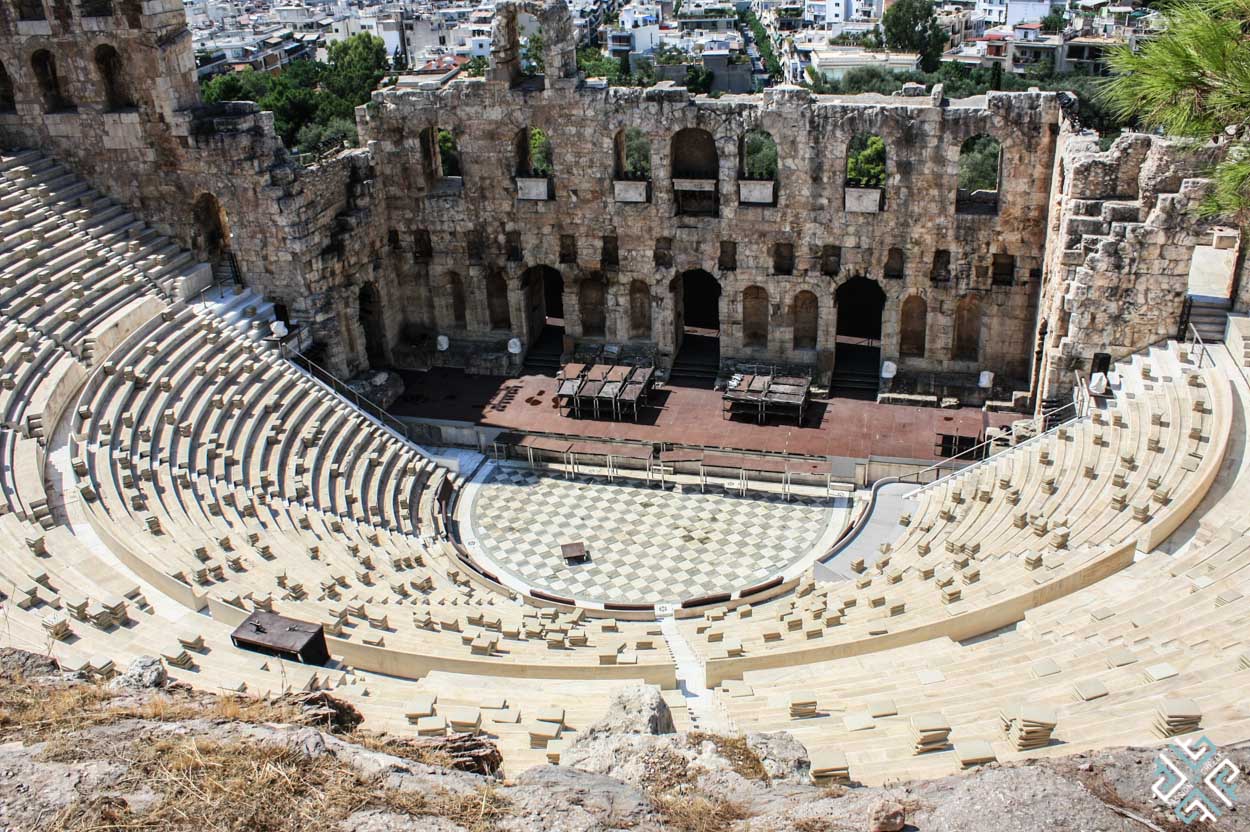
The fate of everything else, everything except architecture, is a different story. And even in architecture Europe lost much. Existing buildings were not only neglected by them, but were actually also vandalized and often destroyed, and many building techniques were forgotten. Streets and bridges made by the Pagans were still used, but they built no new roads and did not maintain the old ones. The new bridges they built were of vastly inferior quality, and none of them survived time. The old roads and bridges, built by Pagans, survived only because they had been so well made. Public baths, sewers and aqueducts were destroyed by them, or left unused. Eventually they collapsed, of course. When you see images of Ancient Greek open theaters, overgrown and abandoned, you must understand that they did not “fall out of use”, but the use of theaters was banned by the Christians! Acting only survived as Christian propaganda, and this was done as in religous plays in the churches themselves.

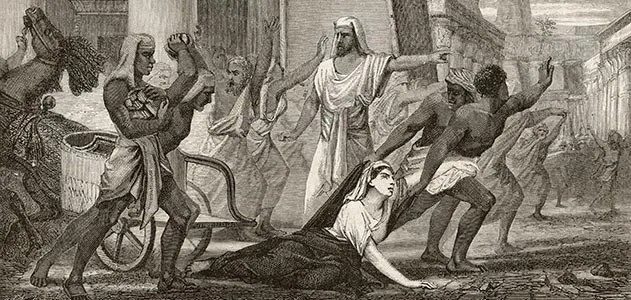
Below: Hypatia (a Greek living in Alexandria, then part of the East Roman Empire) murdered, by a Christian mob.

Old Pagan philosophy schools, sports arenas, baths, horse racing courses, libraries, and so forth were all shut down. More than ten thousand libraries in Europe were burnt down by the Christians! Sport itself was suppressed and partly survived only because it was practiced in remote locations out of reach of the power of the church. Only religious sculptures were allowed, and they were made of inferior materials and in a quality and with a technique vastly inferior to that of the Ancient Pagan world, and nothing even half-way comparable to the Ancient sculptures were made until the Renaissance (of Pagan ideas and ideals!).

When it comes to philosophy, the Church burnt all existing works, with only a few exceptions (mainly in the East Roman Empire), where they kept them hidden from the public. They established a monopoly for philosophy. Real philosophers were censored, persecuted, and even murdered. Nothing of any value was made from the time the Christians murdered Hypatia during the Christianization of Greece, until the Renaissance, when ancient Pagan philosophy was revived. And I may add that the Renaissance was possible only because the Muslims had kept much of the Ancient philosophical works that they had come across. When the Muslims were defeated, in Spain and Portugal, as well as in North Africa and the Middle East, many of these ancient Pagan works were found by European knights, and brought back to Europe. Also, when the Muslims defeated the East Roman Empire, and sacked their capital, the old libraries of the elite, where the Christians had secretly kept some of the ancient European texts, were plundered by the fleeing Greeks, who brought these books as refugees to Italy (mainly). Books were very valuable at the time, so they did that to sell them them; to make sure they would have some money when they arrived, and thus an ability to survive there.

Education was common in the Ancient world, and everyone had been taught to read and write. Public schools were built and paid for by the rich! After Christianity though, all education was denied for almost all Europeans, except to a few rich people and those who planned to become priests. Education became limited to Christian indoctrination.

It does not stop there though! Dance was banned as “Pagan”, tribalism was of course banned and replaced by Christian kingdoms, history was replaced by pure fabrications and lie-propaganda, and mathematics was treated as Pagan philosophy and was reduced to the simple arithmetic needed to calculate the date of Easter. All medicine was banned, and diseases were instead seen as rightful punishment for sins. Hygiene was abandoned as un-Christian. Painting too was banned, except for religious themes for use in Christian propaganda and churches. Pre-Christian art was destroyed whenever they came across it. Most painting techniques were forgotten, and lost for centuries, until they were re-discovered because of the Renaissance (of Pagan ideas and ideals).

When you see magnificent paintings and sculptures appearing in Christian Europe, in the 14th century, this is because of the Renaissance of Pagan ideas and ideals.

And how did the Christians react to that!?

Yes! This is the moment in history when they started burning “witches”. They saw their monopoly and power disappear, as more and more Europeans returned to their own roots and embraced Pagan ideas and ideals again. So the Christians fought back, to keep their power! They did that by murdering more Europeans, by torturing them and burning them alive, in public, to “scare straight” the Europeans. And of course, they murdered mainly those who were the keepers of the Pagan traditions: women. In particular the midwives.

Yes! The Pagan tradition was kept mainly by women, just like all traditions even today are. Mainly women keep the traditions. Without our women, even Yule and Easter, would have been lost ages ago already.

And this is where it gets interesting, because the church mainly murdered women in Protestant countries. Why?

Well, the Protestant countries were “by chance” also the countries that had been Christianized last. In Southern Europe, the Christians had destroyed everything Pagan for hundreds of years already, even for a thousand years, so there was very little left to destroy there. Even the populations themselves were largely mixed with North Africans and Semitic peoples. When the Renaissance re-kindled old ideas and ideals there, and not least skills, the Pagan awakening was not as dramatic as it was when these ideas and ideals reached Central, Western and Northern Europe. In these mainly Protestant parts of Europe the European blood was still overwhelmingly dominant. The Pagan memory was still very much alive. Christianity had not yet had the time to destroy their blood and heritage completely. It was still “too easily” re-kindled there. And dramatic measures were necessary, to stop that!

I can add that when they had burnt most of our midwives, the traditional sages and keepers of (Pagan) traditions in Europe, they replaced them with male doctors, and the mortality rates for both new-borns and women giving birth sky-rocketed. When it had been fairly safe to give birth before, it from then on became incredibly dangerous to give birth.

An ancient Greek theater. Fallen into ruins, because the Christians BANNED theaters. Partly repaired in modern times.

The conclusion I will draw from all of this, is that yes, architecture survived Christianity, and “glorious” temples for their Semitic “god” were indeed built in Europe, before the Renaissance of Pagan ideas and ideals, but everything else was banned and if possible destroyed by Christianity. Intellectually and spiritually, and even physically, Europe was sent into a dark abyss by the Christians, and we only survived because we found back to our Pagan roots.

We are still in this dark and dangerous Semitic abyss. But we are slowly and surely saving ourselves, from the plague called Christianity. Many keep falling, and err in the darkness, but many others or later also manage to climb out and see the light again. Like people emerging from Plato´s cave. Thankfully, only some of us, the most broken, useless and worthless amongst us, are still blinded by the idiotic lies of Christianity.

What started with the Renaissance is not over yet. We are still waking up. And fear not, fellow Europeans! We will wake up completely, before they manage to destroy us and wipe our name from the records of man.