Long before modern hospitals, psychologists, or neuroscientists, our ancestors developed elaborate rituals to preserve identity, memory, and knowledge across generations. Interestingly, this was a system remarkably akin to modern techniques used to treat amnesia. While cloaked in myth, symbolism, and ritual, these practices were far from arbitrary. They were designed with purpose, subtlety, and astonishing psychological insight.
The Pagan traditions, sacred items, burial mounds, and ceremonial acts were tools to restore the memory and identity of returning souls or reincarnated children. Items buried with ancestors weren’t intended merely to accompany them in some afterlife, they served as anchors for memory, cues to help the newly incarnated recognize themselves and reclaim the knowledge, skills, and possessions of past lives.
A trusted guide (often called a sorcerer, druid, or “midwife of the mind”) would oversee this process, ensuring that only the rightful individual could reclaim their legacy. These guides were ritualistically trained to present objects, locations, and symbols in ways that awakened recognition and understanding.
Most myths, far from being whimsical tales, encode this memory-restoring process, as explained and exemplified in detail by my wife (Marie Cachet) in her book, The Secret of the She-Bear.
Today, therapists use remarkably similar methods to help amnesia patients:
Patients are exposed to personal items, photos, or objects tied to strong emotional memories (= burial mound possessions).
Familiar environments are used to trigger recognition and memory reconstruction (= sacred places, sacred trees, ceremonies, traditions).
Guided therapy helps patients restore identity and integrate lost knowledge (= the guidance of the sorcerer).
The logic is the same: memory is recovered through context, emotional attachment, and guided recognition. Ancient Pagan rituals accomplished the same thing, but in symbolic, narrative, and ritualized form.
Conclusion:
These practices were not arbitrary or naïve. They reveal that our ancestors had a systematic understanding of how memory and identity could be restored across lifetimes. To remember was to return; to recover not only knowledge, but the very self carried from a prior existence. What modern neuroscience describes clinically, ancient rituals achieved symbolically and ritually, with the same underlying logic of continuity.
By studying these traditions, we uncover not superstition, but a rational framework of practical intelligence: a method by which reincarnation was guided, memory was reawakened, and identity was re-established in the living.
Quite often, I see Judeo-Christians attack Pagan deities for “cross-dressing”. At the same time, their clergy, priests as well as monks, literally cross-dress 100% of the time. Yes! Your priests and monks are wearing DRESSES (robes). They are ALL cross-dressers.
Now, I know WHY they do this, so let me explain….
Our (Pagan) traditions are based on animism, the idea that there is a spirit in everything. These spirits, however, are not always clear-cut male or female. In fact, they are pretty much always hermaphroditic (both male and female). Therefore, in some European cultures, e. g. the Sun Deity was a God (like in the Greek one), and in others (like the Germanic one) a Goddess. In reality, though, the Sun deity was both male and female – everywhere.
Our forebears believed in sympathetic magic, meaning that you gain the power of what you impersonate or pretend to be. So to gain the power of a deity, they dressed up as that deity, and basically LARPed as that deity. By doing so they BECAME that deity!
Now, since the deities were both male and female, this meant that a man impersonating the deity would have to put on a robe, i. e. women’s clothing, because the deity was both male and female. And, likewise, a woman impersonating a deity had to put on man’s clothing on her upper body. For the same reason.
Now, Judeo-Christianity is completely and utterly just a cheap copy of Pagan religions, where all sorts of Pagan ideas and myths and ideals have been swallowed raw (and never digested or understood), so naturally, their clergy is just like the PAGAN “clergy”: they too “cross-dress”. Although, they have no idea WHY, and it makes ZERO sense for them to do so, and they have ZERO power over anything at all. It just proves that they never understood the customs they copied from Pagan religions.
Yet, this is the reason WHY the Judeo-Christian priests and monks dress as WOMEN. This is the why they are all cross-dressers.
In the case of the Pagans, it had nothing whatsoever to do with what we today think of as cross-dressing, there was nothing sexual about it, but as we know from crime statistics, it might well be related to that for Judeo-Christian clergymen, who are, as we all know, massively over-represented in rape cases and sexual abuse cases against especially same-sex children.
If you go to Amazon to look for books about runes you find dozens upon dozens of books about rune divination. Some thin and some thick, and they all offer you a way to divinate with runes; to predict the future. Many of them combine their “rune lore” with tarot cards, meditation, Yoga and all sorts of other Oriental practices.
Strangely enough, if we look for their sources for their seemingly immense knowledge about rune divination, we find very little.
That is, at first glance we find a lot. There are mentions of runes used for divination in The Saga of Sigurd the Dragonslayer, in The Volsung Saga, in The Saga of the Greenlanders, in The Saga of the People of Laxardal, in The Saga of the Sworn Brothers as well as in The Saga of Egil Skallagrimsson.
That is, if you read the English translations of these texts….
Yes. If you read the English translations….
If you read the original texts though, you will find that the term “rúnar” (runes) are not mentioned even one single time in any of these texts. Instead you will see that the Norsemen carved “stafir” on pieces of wood, to predict the future. Or rather, to let chance decide.
Scholars agree though, that “stafir” must have been a reference to runes. But if they had carved runes on pieces of wood, why not call them runes!? It is not like this was not a well-known term back then. They had runes. They knew the runes. So why not call them runes, if they carved runes into pieces of wood? Ok, if they wrote “runes” in one saga, and “stafir” in another, we can agree that they used these terms interchangeably, but this is not the case. They only use the term “stafir” for this. Never “rúnar”. Let this sink in: in all those sagas, not once is the term “rúnar” used.
I can mention, that in Tacotus´ “Germania”, there is mentioned that symbols are carved unto some pieces of wood, for the same purpose as given in the sagas: to let chance decide. And again, the term “rúnar” are not used, and I may add: from what we know runes did not even exist at the time. He wrote his book around 2000 years ago. The oldest runes found are about 1800 years old.
Well, I think the runes existed back then too, they are probably older than we think, but there is indeed no mention of them being used for divination anywhere. Not in “Germania”, and certainly not in any of the sagas.
What we know instead, is that the Ancient Germanic tribes used “symbols” carved into pieces of wood, and that the Scandinavians used “stafir”. And it was done not to “predict the future”, but to let chance decide.
And yes, when they did not know any better, the ancients often let chance decide. “Shall we go to war over this or not?” If they could not decide, they would place their spears on the ground, and let a young man ride a horse over them. If the horse stepped on one of the spear shafts, it meant “war”. If it did not, it meant “no war”. They knew perfectly well that this was a game of chance. More commonly though, as we know from “Germania” and the sagas, they carved some symbols into pieces of wood, and threw them to the ground, to let chance decide. Like we throw a coin into the air today, “head or “tails”, or cast a die. To let chance decide.
If you look up the word “stafr” (plural: “stafir”) in a Norse dictionary, you will find this: “Staff, walking stick, stick, pillar” and also “used for signs telling you where the property ends/starts”. But then at the very end, they add “rune”…. not because it means rune though, but because the scholars think that all the references to “stafir” in the sagas are actually references to runes. So they added this meaning to the term. Then when they translate the texts into English, “stafir” is therefore translated into “rune”.
Norse “Stafr” derives from proto-Germanic “stafaz”, meaning “staff” or “stick”. It does not mean rune. Scholar believe that it is used to mean “rúnar” in the sagas, but that is pure speculation. And their argument ends up being circular, because they gave “stafir” that meaning”, and then they use their own dictionaries to “prove” that the “Vikings” used runes for “divination”.
My simple claim is that they are wrong, and that if they had used runes for this, then they would have used the term runes too, in the sagas. At least once. But they don´t.
***
The next thing we need to discuss in this context, is how the runes are used for “divination”. Not historically, and certainly not in the sagas, as I have explained above, they were never used for that, but in modern times. In this “New Age”…. In the dozens of dozens of “rune divination” books out there.
What is it they base their interpretations of the runes themselves on? What do we know about the runes!? How are they able to give you complex and intricate predictions, using the runes?
Well. We have rune carvings, of course. Most of them just say “ek erilaz” (“I am (now) noble”). They don´t actually say anything about the runes themselves though. So… we learn nothing about the meaning of each individual rune from that.
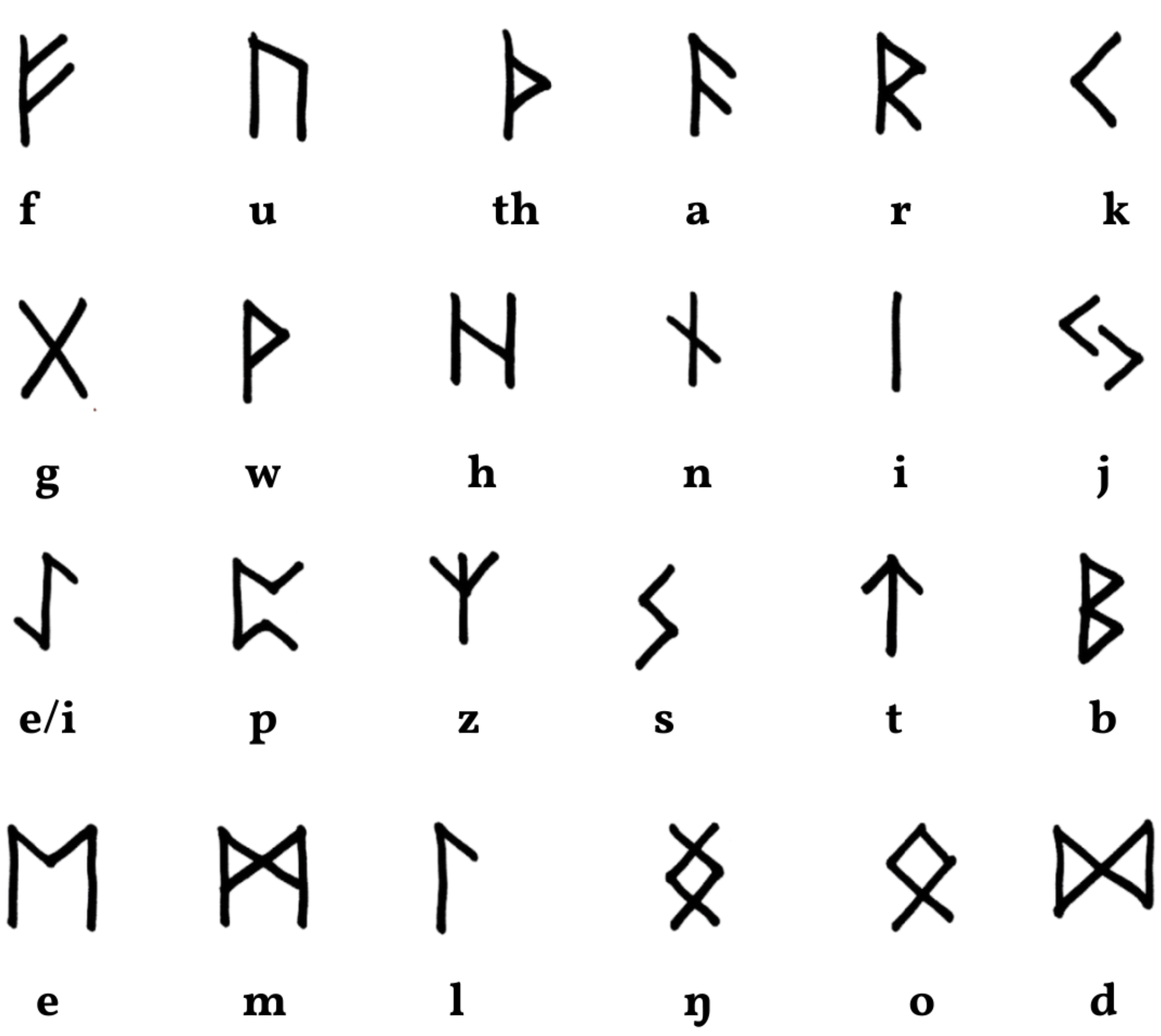
What we have are the rune poems. They are our sole source for the names of the runes, and also the only information we have about each rune. We have 16 Old Norwegian poems, 16 Icelandic poems and 29 Anglo-Saxon poems. I am not going to list them all here, or translate them all, you can find them all translated in my wife´s “The Runes Finally Explained” book, but I will give you an example.
The Old Norwegian (13th century) poem for the rune Féhu is:
Fé vældr frænda róge;
føðesk ulfr i skóge.
This is commonly translated into:
Wealth causes strife among kin;
the wolf is raised in the forest.
This translation was done by a scholar, ages ago, and all scholars since him have used his translation. You know… “sources”. Not one of them seem to have tried to translate this on their own. If they had they would have found his translation to be sorely lacking.
Again, they have given a meaning to the term that was not there originally. Fé translates as “cattle”, you see, and indeed, historically wealth has been measured in how many cows a person had. And because of that they claim “Fé” means “Wealth”. But it means “cattle”.
Also, “vældr” does not mean “causes” at all. It means “controls”. As if that was not enough, the term “róge” does not mean “strife” at all. It means “dispute”.
Yeah. Of the 4 words in the first line, 3 of them are mistranslated…
How is that even possible!? Are they doing this intentionally, or what?
The second line is also mistranslated, although less so than the first line. “Føðesk” does not mean “is raised” at all. It means “gives birth”. Quite a different meaning, isn´t it?
The poem correctly translates as:
Fé (cattle) controls the dispute of the friends;
the wolf gives birth in the forest.
I could go on, and show you how almost every single line in every single poem is mistranslated, but that is what my wife does, in her “The Runes Finally Explained” book, so I will leave it with this.
My point though, is that the rune poems used as a source for all the made-up “rune divination” practices are themselves mistranslations.
The problem is that the scholars who translated these poems did not understand them. They found no meaning to them. I am sure they could have translated them correctly, if they wanted to, but this correct translation made no sense to them, so they mistranslated them intentionally in an attempt to give them some meaning. They still made little sense though, and in the end the rune poems were written off as “meaningless” and “nonsensical”, and “basically no more than the Scandinavian equivalent of “A for Alpha, B for Beta, etc.”.
If you understand the correct translations though, they make perfect sense, as demonstrated by my wife in her rune book.
But let us return to the subject of rune divination here. My point is that these scholarly mistranslations are the original source of information for all who try to give the runes a meaning. We literally have no other information about the meaning of the individual rune signs anywhere! Well, now we have my wife´s book, of course, explaining what they actually mean, but this is not the source for these New Age “rune divination” books, I can assure you.
Note also, that there is nothing anywhere, in any source, telling us how they supposedly used runes for divination. At best, what we know is that the “stafir” (and not runes…) were carved on some pieces of wood. And that is all we know about it…
***
To conclude this…
In reality the very idea of “divination with runes” is speculative nonsense. As I have showed you, there is no real evidence that they ever used runes for that. As if that was not enough, the powers they attribute to each rune, when they MAKE UP a way to “predict the future with runes” are, just modern interpretations of mistranslations of rune poems…
“Rune divination” is nothing but a scam. The people who write these books are scam artists, who “make up shit” and then present it as “Norse practices”.
The scholars, who see the rune poems as “meaningless”, are not much better.
In reality, as demonstrated by my wife in her “The Runes Finally Explained”, the runes have deep meaning, deep purpose, and are very much an important part of our heritage, supported by mythology and traditions.
The runes are not used for divination. They are divine…
I can add that when runes are mentioned in mythology, in Hávamál, they are mentioned with rebirth: when Ódinn is reborn (again) as he falls down from the tree of life, and picks up the runes.
When I argue that Christianity suffocated Europe intellectually and spiritually, and left our culture and populations dramatically reduced in all ways, the standard reaction from Christians is to show images of the “magnificent” cathedrals built by the Christians in the Middle Ages. This is supposed to prove that I am wrong, and that Christianity did not actually turn Europeans into ignorant, filthy, broken and dramatically reduced primitives. Instead, we, they argue, became better and started to build glorious temples for the new Semitic idol. Because “of course”, before Christianity we were indeed ignorant primitives.
You can of course easily list endless examples of “glorious” buildings in biological Europe from before Christianity had even been invented. All the seven wonders of the Ancient World were built by Pagans. Every single one of them. The Greeks built magnificent temples to their Pagan Gods, and the Romans did too. They also built aqueducts, bridges, sewers, theaters and more, en masse, and even the “barbarians” of Europe built magnificent ships, the Stone Henge, the New Grange burial mound, and numerous beautiful wooden temples. Only someone extremely ignorant will believe in the lies of the Christians. Even civilization itself was built by Pagans. In Europe by the Romans and Greeks. And it barely survived Christianity!
But they are correct that the architecture skills in Europe survived Christianity. And it did because the Christians wanted to build temples to their immigrant idol, to impose their Semitic beliefs on the Europeans, to force them to worship their Hebrew tribal “god”, to scare them and to ensure control. These temples were not only temples, but also intelligence gathering centers, where any and all opposition could be picked up, identified and “dealt with”.
And they did “deal with” the Pagans in all areas they took over. They burnt the Pagan temples, often with the Pagan priests inside, executed all who refused to bend their knee to the new Semitic idol and ruthlessly rooted out all European culture, as best as they could. When they failed, they Christianized it instead, and made it part of their own alien cult. Like they did with all our Pagan festivals.
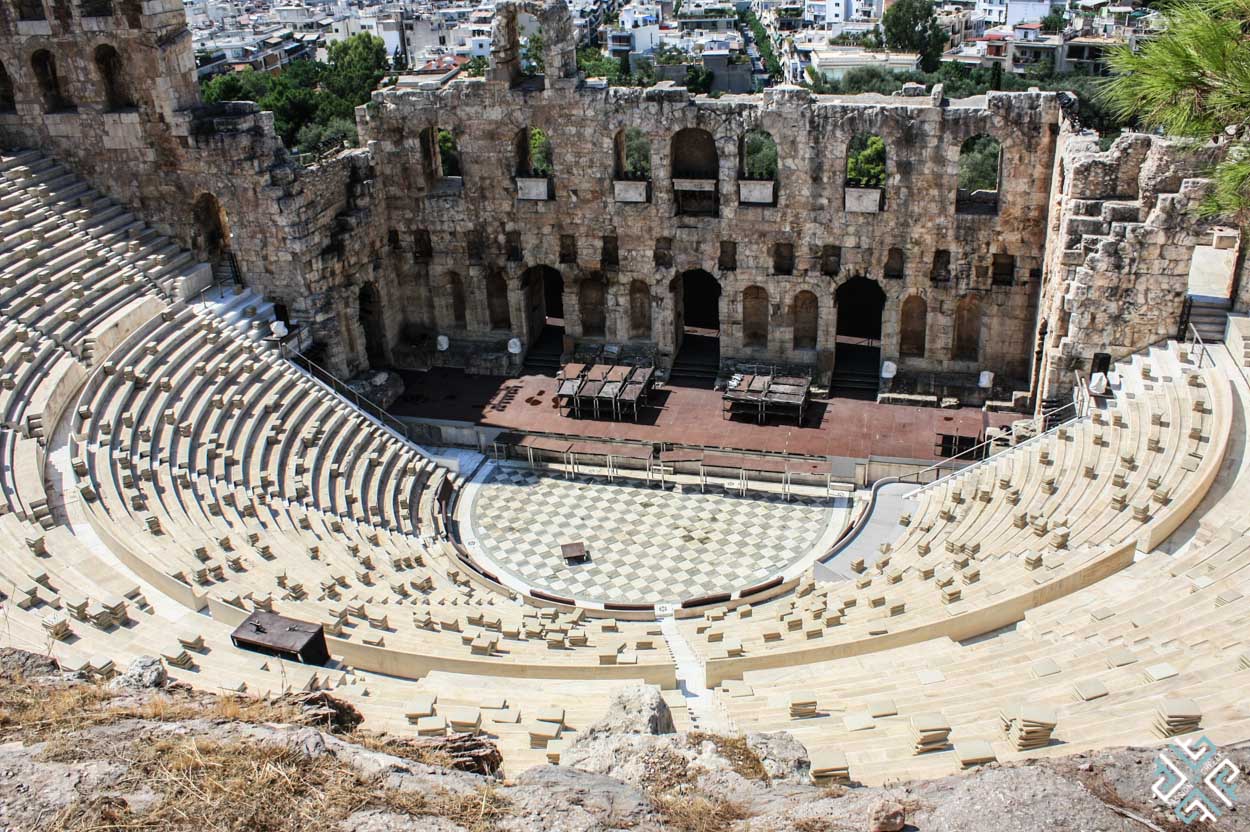
The fate of everything else, everything except architecture, is a different story. And even in architecture Europe lost much. Existing buildings were not only neglected by them, but were actually also vandalized and often destroyed, and many building techniques were forgotten. Streets and bridges made by the Pagans were still used, but they built no new roads and did not maintain the old ones. The new bridges they built were of vastly inferior quality, and none of them survived time. The old roads and bridges, built by Pagans, survived only because they had been so well made. Public baths, sewers and aqueducts were destroyed by them, or left unused. Eventually they collapsed, of course. When you see images of Ancient Greek open theaters, overgrown and abandoned, you must understand that they did not “fall out of use”, but the use of theaters was banned by the Christians! Acting only survived as Christian propaganda, and this was done as in religous plays in the churches themselves.
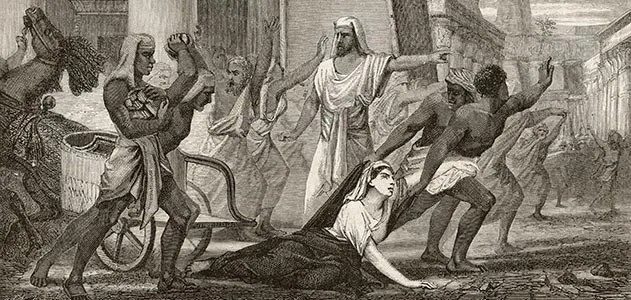
Below: Hypatia (a Greek living in Alexandria, then part of the East Roman Empire) murdered, by a Christian mob.
Old Pagan philosophy schools, sports arenas, baths, horse racing courses, libraries, and so forth were all shut down. More than ten thousand libraries in Europe were burnt down by the Christians! Sport itself was suppressed and partly survived only because it was practiced in remote locations out of reach of the power of the church. Only religious sculptures were allowed, and they were made of inferior materials and in a quality and with a technique vastly inferior to that of the Ancient Pagan world, and nothing even half-way comparable to the Ancient sculptures were made until the Renaissance (of Pagan ideas and ideals!).
When it comes to philosophy, the Church burnt all existing works, with only a few exceptions (mainly in the East Roman Empire), where they kept them hidden from the public. They established a monopoly for philosophy. Real philosophers were censored, persecuted, and even murdered. Nothing of any value was made from the time the Christians murdered Hypatia during the Christianization of Greece, until the Renaissance, when ancient Pagan philosophy was revived. And I may add that the Renaissance was possible only because the Muslims had kept much of the Ancient philosophical works that they had come across. When the Muslims were defeated, in Spain and Portugal, as well as in North Africa and the Middle East, many of these ancient Pagan works were found by European knights, and brought back to Europe. Also, when the Muslims defeated the East Roman Empire, and sacked their capital, the old libraries of the elite, where the Christians had secretly kept some of the ancient European texts, were plundered by the fleeing Greeks, who brought these books as refugees to Italy (mainly). Books were very valuable at the time, so they did that to sell them them; to make sure they would have some money when they arrived, and thus an ability to survive there.
Education was common in the Ancient world, and everyone had been taught to read and write. Public schools were built and paid for by the rich! After Christianity though, all education was denied for almost all Europeans, except to a few rich people and those who planned to become priests. Education became limited to Christian indoctrination.
It does not stop there though! Dance was banned as “Pagan”, tribalism was of course banned and replaced by Christian kingdoms, history was replaced by pure fabrications and lie-propaganda, and mathematics was treated as Pagan philosophy and was reduced to the simple arithmetic needed to calculate the date of Easter. All medicine was banned, and diseases were instead seen as rightful punishment for sins. Hygiene was abandoned as un-Christian. Painting too was banned, except for religious themes for use in Christian propaganda and churches. Pre-Christian art was destroyed whenever they came across it. Most painting techniques were forgotten, and lost for centuries, until they were re-discovered because of the Renaissance (of Pagan ideas and ideals).
When you see magnificent paintings and sculptures appearing in Christian Europe, in the 14th century, this is because of the Renaissance of Pagan ideas and ideals.
And how did the Christians react to that!?
Yes! This is the moment in history when they started burning “witches”. They saw their monopoly and power disappear, as more and more Europeans returned to their own roots and embraced Pagan ideas and ideals again. So the Christians fought back, to keep their power! They did that by murdering more Europeans, by torturing them and burning them alive, in public, to “scare straight” the Europeans. And of course, they murdered mainly those who were the keepers of the Pagan traditions: women. In particular the midwives.
Yes! The Pagan tradition was kept mainly by women, just like all traditions even today are. Mainly women keep the traditions. Without our women, even Yule and Easter, would have been lost ages ago already.
And this is where it gets interesting, because the church mainly murdered women in Protestant countries. Why?
Well, the Protestant countries were “by chance” also the countries that had been Christianized last. In Southern Europe, the Christians had destroyed everything Pagan for hundreds of years already, even for a thousand years, so there was very little left to destroy there. Even the populations themselves were largely mixed with North Africans and Semitic peoples. When the Renaissance re-kindled old ideas and ideals there, and not least skills, the Pagan awakening was not as dramatic as it was when these ideas and ideals reached Central, Western and Northern Europe. In these mainly Protestant parts of Europe the European blood was still overwhelmingly dominant. The Pagan memory was still very much alive. Christianity had not yet had the time to destroy their blood and heritage completely. It was still “too easily” re-kindled there. And dramatic measures were necessary, to stop that!
I can add that when they had burnt most of our midwives, the traditional sages and keepers of (Pagan) traditions in Europe, they replaced them with male doctors, and the mortality rates for both new-borns and women giving birth sky-rocketed. When it had been fairly safe to give birth before, it from then on became incredibly dangerous to give birth.
An ancient Greek theater. Fallen into ruins, because the Christians BANNED theaters. Partly repaired in modern times.
The conclusion I will draw from all of this, is that yes, architecture survived Christianity, and “glorious” temples for their Semitic “god” were indeed built in Europe, before the Renaissance of Pagan ideas and ideals, but everything else was banned and if possible destroyed by Christianity. Intellectually and spiritually, and even physically, Europe was sent into a dark abyss by the Christians, and we only survived because we found back to our Pagan roots.
We are still in this dark and dangerous Semitic abyss. But we are slowly and surely saving ourselves, from the plague called Christianity. Many keep falling, and err in the darkness, but many others or later also manage to climb out and see the light again. Like people emerging from Plato´s cave. Thankfully, only some of us, the most broken, useless and worthless amongst us, are still blinded by the idiotic lies of Christianity.
What started with the Renaissance is not over yet. We are still waking up. And fear not, fellow Europeans! We will wake up completely, before they manage to destroy us and wipe our name from the records of man.


 Thulean Perspective